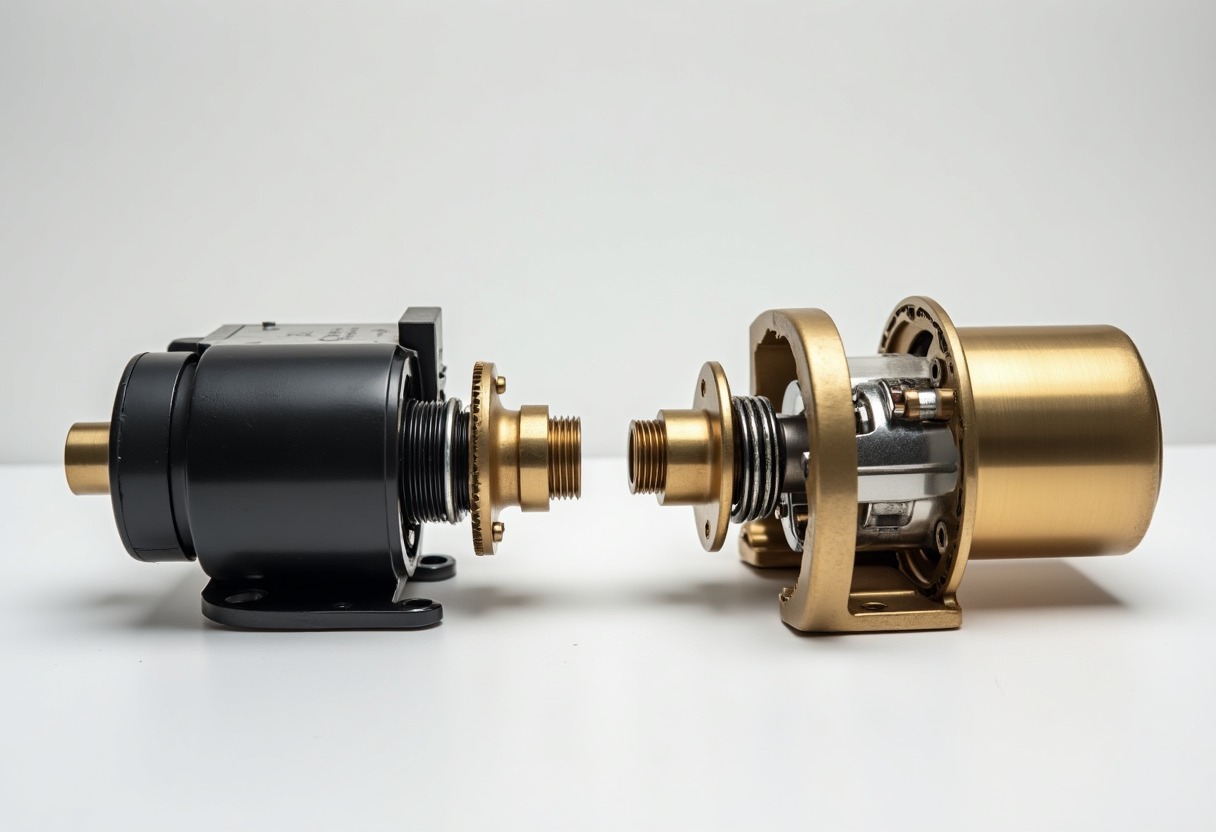
Your espresso machine's pump dictates how stable your 9-bar pressure stays during extraction, how much vibration rattles through your countertop, and whether you can plumb the machine directly into your water line. Yet most buying guides gloss over pump type like it's a footnote. The difference between a vibratory Ulka pump and a gear-driven rotary changes your entire workflow — from puck preparation sensitivity to whether you can pull back-to-back shots without pressure decay.
Why Pump Type Determines More Than Just Pressure Numbers
Both rotary and vibratory pumps can hit the industry-standard 9 bars of pressure, but they achieve it through fundamentally different mechanisms. A vibratory pump — the Ulka series being the most common — uses an electromagnetic piston that oscillates 120 times per second to pulse water through the grouphead. A rotary pump spins continuously, pushing water through gears or vanes at a steady flow rate.
The mechanical difference shows up immediately in extraction consistency. Vibratory pumps deliver pressure in rapid pulses, which most espresso research acknowledges creates micro-fluctuations during the shot. These fluctuations don't necessarily ruin espresso — millions of shots pulled daily on Gaggia Classics prove that — but they introduce a variable you can't control. Rotary pumps maintain near-constant pressure across the entire extraction window, which matters when you're profiling with flow control devices or working with light-roasted single origins that demand precision.
Pressure stability also affects how forgiving your puck preparation needs to be. A vibratory pump's oscillations can expose channeling more aggressively if your distribution is uneven, while a rotary pump's smooth delivery sometimes masks minor prep mistakes — not an excuse for sloppy technique, but a real-world consideration when you're rushing a morning shot.
Vibratory Pumps: The Workhorse of Consumer Espresso Machines
Vibratory pumps dominate the home espresso market because they're compact, inexpensive to manufacture, and perfectly adequate for reservoir-fed machines. The Ulka EP5 pump powers everything from $400 Gaggia models to $1,200 Rancilio Silvias. These pumps draw water from a reservoir, push it through the boiler, and send it to the grouphead at roughly 9 bars — adjustable via an internal pressure spring.
The noise signature is unmistakable: a buzzing vibration that transfers through the machine chassis and into your counter. Some users describe it as meditative; others find it grating at 6 AM. The vibration isn't just acoustic — it physically shakes the machine, which is why proper tamping and WDT technique matter more on vibratory pump machines. Any looseness in your puck gets amplified.
Durability sits around 5-7 years of daily home use, though this varies wildly based on water quality and duty cycle. Hard water accelerates calcium buildup inside the pump chamber, which eventually restricts flow or causes complete failure. → Shop vibratory pump replacement parts on Amazon if you want to extend the life of a beloved machine. Replacement is straightforward — usually four screws and two water line connections — making vibratory pumps the repairable choice for home users.
The key limitation: you can't plumb a vibratory pump directly to your water line without an expansion tank or flow restrictor. These pumps aren't designed for continuous inlet pressure, so running city water directly into them risks damaging the solenoid or creating backflow into your home plumbing.
Rotary Pumps: Café Reliability Comes Home
Rotary pumps — usually rotary vane or gear types — are what you'll find in commercial two-group machines pulling 200 shots per day. They spin continuously at 1,400-1,600 RPM, creating consistent pressure without the electromagnetic pulsing of vibratory designs. The mechanical advantage is immediate: near-silent operation, zero vibration, and pressure curves that stay flat within 0.2 bars across the entire shot.
This stability transforms pressure profiling from a theoretical nicety into a practical tool. When you reduce flow mid-shot to extend extraction time, a rotary pump responds smoothly. A vibratory pump's pressure oscillations make it harder to feel the difference between 6 bars and 7 bars when you're manually controlling flow. Machines like the Profitec Pro 700 or Lelit Bianca V3 pair rotary pumps with flow control paddles specifically because the pump's linearity makes profiling intuitive.
Longevity stretches past 15 years with proper maintenance — commercial machines routinely hit two decades. Rotary pumps self-lubricate through the water they're pumping, so water quality directly affects lifespan. Poor filtration allows mineral deposits on the vanes, which creates drag and eventual failure. Most manufacturers recommend annual descaling and water softening if your TDS exceeds 150 ppm. Check your water quality before upgrading to a rotary pump machine.
The plumbing advantage is non-negotiable for some users: rotary pumps handle direct water line connection effortlessly. → Shop plumb-in espresso kits on Amazon to eliminate reservoir refilling. This matters less if you're pulling two shots per day, but if you're steaming multiple lattes or entertaining frequently, reservoir capacity becomes a real workflow bottleneck.
Cost is the obvious trade-off. Rotary pump machines start around $1,800 (Profitec Pro 500) and climb past $4,000 quickly. You're paying for the pump mechanism itself — which costs 10x more than a Ulka — plus the heavier-duty internal components required to match the pump's longevity.
Comparison: Vibratory vs Rotary Pump Performance
| Feature | Vibratory Pump | Rotary Pump | |---------|----------------|-------------| | Pressure Stability | ±0.5-1.0 bar fluctuation during extraction | ±0.1-0.2 bar variation across entire shot | | Noise Level | 65-75 dB, audible buzzing and vibration | 45-55 dB, near-silent mechanical hum | | Lifespan (Home Use) | 5-7 years average, ~5,000 shot cycles | 15-20 years typical, ~50,000+ shot cycles | | Plumbing Capability | Reservoir only (or expansion tank required) | Direct water line compatible out of box | | Pressure Profiling | Functional but less precise feedback | Smooth, linear response ideal for profiling | | Typical Machine Cost | $400-$1,500 consumer machines | $1,800-$5,000+ prosumer/commercial-grade |
The table illustrates why pump type matters more as you move up the espresso ladder. If you're still dialing in basic technique with grind adjustments and temperature stability, a vibratory pump won't hold you back. But once you're profiling light roasts or chasing shot-to-shot consistency within 1-2 second variance, rotary pressure delivery becomes a real advantage.
Which Pump Type Belongs in Your Setup
Match the pump to your actual workflow, not aspirational ideals. If you pull 1-2 drinks per morning, refilling a 2-liter reservoir once per week isn't a burden. Vibratory pumps in machines like the Rancilio Silvia or Gaggia Classic Pro deliver excellent espresso when paired with quality grinders. Save the $1,500+ premium for beans, better grinder burrs, or a proper tamper.
Consider a rotary pump machine if:
- You're pulling 4+ drinks daily and reservoir refilling disrupts your flow
- You want to plumb the machine permanently into your kitchen water line
- You're already profiling shots and need finer pressure control
- Noise matters (early morning shots, open-concept kitchen, sleeping household)
- You're planning to keep this machine 10+ years and want commercial-grade reliability
→ Shop rotary pump espresso machines on Amazon to see current pricing on models from Profitec, Lelit, and Rocket. These machines typically include rotary pumps alongside dual boilers, E61 groupheads, and PID controllers — the whole prosumer package. You can't buy just the pump upgrade; it comes bundled with better everything.
If you're unsure, start with a high-performing vibratory machine. You'll learn whether pressure stability actually limits your results or whether grind consistency and temperature control matter more in your specific workflow. Plenty of home baristas pull exceptional shots on Silvias and never feel constrained by the pump.
Pressure Monitoring: The Tool Most Pump Comparisons Ignore
Install a pressure gauge regardless of pump type. → Shop espresso machine pressure gauges on Amazon for analog or digital options that mount inline between your pump and grouphead. Vibratory pumps benefit from gauge monitoring because you can verify whether pressure oscillations are within spec or symptomatic of a failing pump. Rotary pumps let you track pressure decay over thousands of shots, catching failing seals or vane wear before they affect extraction.
Most stock pressure gauges on consumer machines measure at the pump outlet, not at the basket. This reading is optimistic — actual puck resistance drops pressure 1-2 bars by the time water reaches the coffee. A basket-mounted gauge gives you the real number, which changes how you interpret extraction times and taste.
Pre-infusion behavior differs significantly between pump types. Vibratory pumps struggle with true low-pressure pre-infusion (2-4 bars) because their electromagnetic design either pulses at full pressure or shuts off entirely. Some machines fake pre-infusion by running the pump in short bursts, but this isn't the same as sustained low-pressure flow. Rotary pumps can ramp pressure smoothly from 2 bars to 9 bars across 8-10 seconds, which opens up pre-infusion strategies impossible on vibratory designs.
This distinction matters for certain coffee styles. Light-roasted single origins with high density often benefit from extended pre-infusion to hydrate the puck evenly before full pressure extraction. A rotary pump makes this easy; a vibratory pump requires workarounds like temperature surfing or manual lever manipulation.
Maintenance Reality: What Breaks and When
Vibratory pumps fail suddenly. One morning the machine hums but no water flows, or pressure drops to 4 bars and stays there. Diagnosis is straightforward: replace the pump. Cost runs $30-50 for a genuine Ulka EP5, plus an hour of your time if you're comfortable with basic mechanical work. Most local appliance repair shops won't touch espresso machines, so DIY replacement is your realistic option. Online communities around specific machines (Gaggia, Rancilio, Breville) have detailed tear-down guides.
Rotary pumps degrade gradually. You'll notice shot times creeping longer, or pressure dropping 0.5 bars over six months. This slow decline gives you time to plan replacement or rebuild. Rotary vane pumps can often be rebuilt with new vanes and seals for $150-200, extending life another decade. Gear pumps are typically sealed units requiring full replacement, which runs $400-600 depending on model.
Water quality determines maintenance frequency for both types. If you're running city water above 200 ppm TDS without filtration, expect to halve the lifespan estimates above. Calcium binds to metal surfaces inside the pump chamber, restricting flow and creating friction. Proper water filtration isn't optional — it's the difference between 7 years and 3 years on a vibratory pump, or 20 years and 8 years on a rotary.
Descaling procedures differ slightly. Vibratory pumps need more aggressive descaling cycles because their pulsing action tends to leave mineral deposits in the pump chamber's dead zones. Rotary pumps flush more thoroughly during normal operation, but their larger internal volume means you need more descaling solution per cycle.
FAQ
Can I upgrade a vibratory pump machine to rotary?
Technically possible but rarely practical. The pump connects to the boiler, electrical system, and frame mounting points — all designed around the specific pump dimensions. You'd spend more on custom fabrication than buying a machine with a rotary pump from the factory. Better to sell your current machine and upgrade completely.
Do rotary pumps actually make better-tasting espresso?
Not directly. They provide more stable pressure delivery, which improves shot consistency and enables advanced profiling techniques. But a well-dialed vibratory pump shot with proper grind size and technique will taste better than a poorly executed rotary pump shot every time. The pump is one variable in a complex system.
How loud is loud with vibratory pumps?
Most measure 65-75 dB during extraction — similar to normal conversation volume, but with a mechanical buzzing quality that carries through walls. Some machines (Breville Dual Boiler, Lelit Victoria) include vibration dampening mounts that reduce noise to 55-60 dB. Counter material matters: granite and quartz amplify vibration more than wood or rubber mats.
Can I plumb a vibratory pump machine if I add a flojet pump?
Yes, adding a Flojet booster pump between your water line and the machine's inlet creates the low-pressure reservoir simulation that vibratory pumps expect. Costs around $150-200 for the pump and installation kit. Works reliably but adds another potential failure point and doesn't eliminate the fundamental pressure pulsing of the vibratory design.
Which pump type handles back-to-back shots better?
Rotary pumps maintain consistent pressure even during rapid sequential extraction because they run continuously. Vibratory pumps can show pressure drop-off after 2-3 consecutive shots as the boiler struggles to maintain temperature and the pump heats up. If you regularly make four lattes in a row, rotary pumps handle the thermal load more gracefully — though dual boiler designs solve most of this regardless of pump type.
The pump sitting inside your espresso machine determines how forgiving your workflow can be, how long the machine will last, and what techniques you can realistically explore — but it doesn't pull the shot for you.
Some links on this page are affiliate links. We may earn a small commission if you purchase through them, at no extra cost to you.
As an Amazon Associate we earn from qualifying purchases. This article contains affiliate links; if you buy through them we may earn a small commission at no additional cost to you.