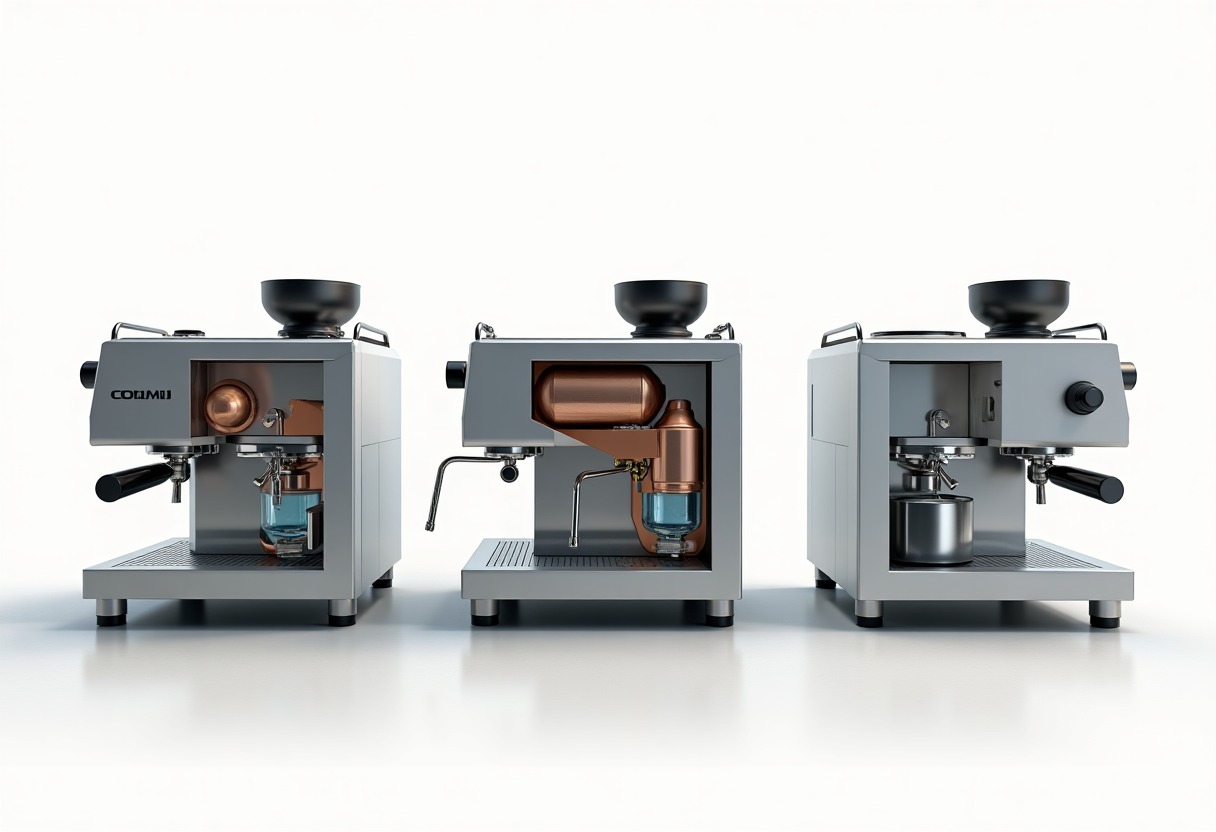
Your espresso workflow dictates which boiler type belongs in your setup. Single boiler machines force you to wait between shots and steaming. Heat exchangers let you pull shots and steam simultaneously but introduce temperature management complexity. Dual boilers give you independent control over brew and steam temps at the cost of counter space and cash.
Why Boiler Configuration Matters More Than Wattage
Boiler type determines three things that actually matter: thermal stability during extraction, back-to-back shot capability, and whether you can steam milk without cooling brew water. A 1,400-watt single boiler will recover slower than a 1,200-watt dual boiler because the dual boiler dedicates one chamber entirely to maintaining brew temperature while the other handles steam pressure.
The Specialty Coffee Association defines optimal brew temperature as 90.5-96°C (195-205°F), with tighter tolerance producing more consistent extractions. Single boilers swing through a wider temperature range during the brew-to-steam transition. Heat exchangers maintain steadier temps but require cooling flushes. Dual boilers hold rock-steady brew temperatures independent of steam demand.
This matters when you're dialing in. A machine that drops 3°C between shots forces you to compensate with grind adjustments. That's not refinement — that's fighting your equipment.
Single Boiler: Sequential Workflow Only
Single boiler machines heat one tank that switches between brew temperature (around 93°C) and steam temperature (around 130°C). You pull your shot, flip a switch, wait 60-90 seconds for the boiler to heat up for steaming, then wait another 3-5 minutes to cool back down for the next shot.
The Gaggia Classic Pro typifies this design. One 100ml aluminum boiler. You extract at brew temp, then activate the steam mode. The → Shop PID espresso machine on Amazon if you want precise temperature control — the stock thermostat swings ±7°C.
Real workflow: pull double shot (25-30 seconds), activate steam mode (75 seconds heat-up), steam milk (45 seconds), wait for brew temp recovery (4-5 minutes minimum). If you're making drinks for two people, plan on 12-15 minutes total.
Benefits: simple mechanical design, fewer failure points, easier to repair, lower purchase price ($300-800). The trade-off is time. Single boiler machines work fine if you make one drink in the morning and you're patient. If you run a home coffee bar setup where you're making multiple drinks on weekend mornings, you'll notice the wait.
Temperature surfing — pulling shots at specific points in the heating cycle — can improve consistency, but requires a → Shop espresso machine thermometer on Amazon and deliberate timing. Not terrible, but not what you signed up for if you care about espresso brew temperature.
Heat Exchanger: Simultaneous Operation With Compromises
Heat exchanger (HX) machines maintain one large steam boiler at 120-130°C. Brew water routes through a tube (the heat exchanger) inside that steam boiler, reaching brew temperature as it passes through. You can pull shots and steam simultaneously because the systems operate independently.
The Lelit MaraX and Rancilio Silvia Pro X use this architecture. One large boiler (typically 300-500ml), with a thermosyphon loop continuously cycling fresh brew water through the heat exchanger. When you activate the pump, cooler line water pushes through the exchanger tube and exits the group at brew temperature.
The issue: the water sitting in that exchanger tube superheats during idle periods. First water out might be 102°C instead of 93°C. Standard practice is a cooling flush — run 1-3 seconds of water through the group before locking in your portafilter. How long depends on how long the machine sat idle and how hot your steam boiler runs.
This adds a variable. Miss the flush and you scorch light roasts. Flush too long and you drop below optimal extraction temperature. The espresso machine PID controller helps on some machines by adjusting steam boiler temperature based on usage patterns, but you still need to develop flush timing through trial.
Benefits: simultaneous brewing and steaming, faster workflow than single boiler, generally less expensive than dual boiler ($800-1,800). Heat exchangers shine in commercial settings where machines run continuously and the exchanger tube never superheats. At home, where the machine sits idle between drinks, you're managing that cooling flush every single time.
Dual Boiler: Independent Temperature Control
Dual boiler machines run two separate boilers — one dedicated to brew temperature, one to steam pressure. You set brew boiler to 93°C, steam boiler to 130°C, and they maintain those temperatures independently. No waiting, no temperature surfing, no cooling flushes.
The Profitec Pro 600, Lelit Bianca, and Decent DE1 represent this category. Two boilers (brew boilers typically 300-500ml, steam boilers 500-1,500ml depending on steaming power desired), two heating elements, two PIDs. The → Shop dual boiler espresso machine on Amazon yields machines starting around $1,400 and ranging past $4,000.
Real workflow: pull shot, steam milk simultaneously or immediately after, pull another shot 30 seconds later with identical brew temperature. Thermal stability stays within ±0.5°C on quality dual boilers. This consistency matters when you're testing espresso extraction yield adjustments or working with pre-infusion timing tweaks.
Benefits: zero workflow compromise, maximum thermal stability, independent temperature adjustment for different roast profiles, better steam power without affecting brew temp. The trade-offs are size (these machines span 12-15 inches wide), heat-up time (25-40 minutes to full temp stability), power consumption (1,400-2,000+ watts), and cost.
If you're making 3-6 drinks consecutively or experimenting with temperature profiling across different coffees, dual boilers eliminate the thermal variable. You're dialing in based on grind, dose, and espresso puck preparation alone.
Boiler Type Performance Comparison
| Boiler Type | Shot-to-Shot Recovery | Brew/Steam Simultaneously | Temperature Stability | Typical Price Range | |-------------|----------------------|--------------------------|---------------------|-------------------| | Single Boiler | 4-5 minutes (full cool-down) | No — sequential operation only | ±5-7°C without PID, ±2-3°C with PID | $300-$800 | | Heat Exchanger | 30-60 seconds (minimal) | Yes — independent paths | ±1-2°C (with cooling flush protocol) | $800-$1,800 | | Dual Boiler | 20-40 seconds (brew boiler only) | Yes — separate boilers | ±0.5-1°C (continuous) | $1,400-$4,500+ | | Dual Boiler (w/ saturated group) | 10-20 seconds (group stays hot) | Yes — separate boilers | ±0.3-0.5°C (continuous) | $2,500-$6,000+ |
That fourth row matters if you're pulling multiple back-to-back shots. A saturated group head (like on the Profitec Pro 700 or Rocket R58) stays thermally connected to the brew boiler, eliminating the group cool-down that happens when you pull water through it. Check espresso group head types for the thermal mass implications.
Which Boiler Type Fits Your Workflow
Single boiler if: You make one or two drinks per session, you're patient, and you prioritize simple maintenance and repair. Pair with a quality grinder like those in best coffee grinders espresso and the machine won't limit your shot quality — just your speed. A modded Gaggia Classic Pro with PID and better steam wand produces excellent espresso at $500 total investment.
Heat exchanger if: You want simultaneous capability without dual boiler cost, you're willing to learn cooling flush timing, and you value the commercial aesthetic. → Shop heat exchanger espresso machine on Amazon for machines in the $1,000-1,500 range. The Lelit MaraX includes temperature control that reduces flush dependency. Matches well with best espresso grinders under 300 for a complete under-$1,800 setup.
Dual boiler if: You make multiple drinks regularly, you're chasing optimal extraction repeatability, or you test different roast profiles requiring precise temperature adjustments. The entry dual boiler machines (Breville Dual Boiler, best espresso machines home 2026) start around $1,400. Mid-range ($2,000-3,000) gets you machines like the Profitec Pro 600 or Lelit Elizabeth with saturated groups and flow control.
Your grinder budget matters more than your boiler configuration until you're spending over $1,000 on the machine. A $600 dual boiler paired with a $200 grinder will produce worse espresso than a $400 single boiler with a $400 grinder. Temperature stability can't rescue poor grind quality.
Thermal Management Beyond Boiler Count
Once you've chosen your boiler type, actual temperature stability depends on group head design, case insulation, and PID tuning. A dual boiler with a poorly insulated group or an aggressive PID algorithm can show worse shot-to-shot consistency than a properly configured single boiler.
Group temperature drops 2-5°C when you pull a shot — water flowing through the metal mass cools it. Three factors mitigate this: group thermal mass (more metal holds more heat), brew boiler connection type (saturated groups stay warmer), and shot recovery time (how fast the group reheats).
Install a → Shop portafilter thermometer on Amazon with a group thermometer probe to measure your actual extraction temperature. You'll find the difference between your PID setpoint and real water temp at the puck. Most machines run 1-3°C cooler at the group than at the boiler.
Warm-up protocols matter more than machine type. Even dual boilers need 20-30 minutes to reach full thermal equilibrium — not just boiler temperature, but group head, portafilter, and all the metal that touches brew water. Pull a blank shot to pre-heat the group, then wait 10 minutes before your first real extraction. That wait eliminates a 3-4°C temperature difference between shot one and shot three.
Pre-warming your portafilter — either by leaving it locked in during heat-up or running hot water through it — prevents the cold portafilter from pulling heat from your first shot. Metal conducts heat fast. A room-temperature portafilter can drop your extraction temp by 2-3°C in the first few seconds.
PID offset tuning compensates for the boiler-to-group temperature drop. If your group runs 3°C cooler than your boiler setpoint, increasing the PID target by 3°C brings actual extraction temperature to your desired number. Some machines (like the Decent) measure group temperature directly. Most measure boiler temp and require you to determine the offset empirically.
FAQ
What's the temperature difference between a heat exchanger and dual boiler during actual extraction?
Heat exchangers typically fluctuate ±1-2°C at the group if you nail your cooling flush. Dual boilers hold ±0.5-1°C. The practical difference appears most clearly on back-to-back shots — the HX may drift slightly as steam boiler temperature affects the exchanger, while the dual boiler maintains consistent brew temp regardless of steam activity.
Can you add a PID to a single boiler machine to match dual boiler stability?
A PID on a single boiler tightens temperature control to ±1-2°C during brewing, which eliminates most of the thermal instability problem. You still can't brew and steam simultaneously, and you still wait for temperature transitions, but shot-to-shot consistency improves dramatically. The Gaggia Classic Pro PID mod costs $100-150 and transforms the machine's repeatability.
How long should a cooling flush be on a heat exchanger machine?
Depends on idle time and steam boiler temperature. After 5 minutes idle at 120°C steam temp, flush 2-3 seconds. After 20+ minutes idle, flush 4-5 seconds. Install a thermometer in your portafilter and measure — you're targeting 91-94°C for most medium roasts. Once you establish timing for your machine, it becomes automatic.
Does a bigger boiler mean better thermal stability?
Bigger boilers provide more thermal mass and resist temperature swings during heavy use, but size matters less than heating element wattage and PID response. A 300ml dual boiler with a 1,200-watt element and tight PID control will outperform a 500ml single boiler with a 900-watt element and mechanical thermostat. Volume helps commercial machines maintain temp under continuous load, but element power determines home machine recovery speed.
Are heat exchangers harder to maintain than dual boilers?
Not mechanically — heat exchangers have fewer components than dual boilers. But HX machines require more consistent descaling because the exchanger tube forms scale quickly at steam boiler temperatures. Using proper espresso water quality filtration matters more on HX machines. Dual boilers separate brew and steam water, so the brew side stays cleaner. Both need regular descaling, but HX machines show performance degradation faster if you skip it.
Pick the Boiler Type That Matches Your Shot Frequency
If you're consistently making milk drinks for multiple people or you want to test temperature profiling across different coffees, dual boilers eliminate enough workflow friction to justify the price. If you make one drink at a time and value mechanical simplicity, single boilers work fine — add a PID and you're set. Heat exchangers split the difference but force you to master the cooling flush.
Some links on this page are affiliate links. We may earn a small commission if you purchase through them, at no extra cost to you.
As an Amazon Associate we earn from qualifying purchases. This article contains affiliate links; if you buy through them we may earn a small commission at no additional cost to you.