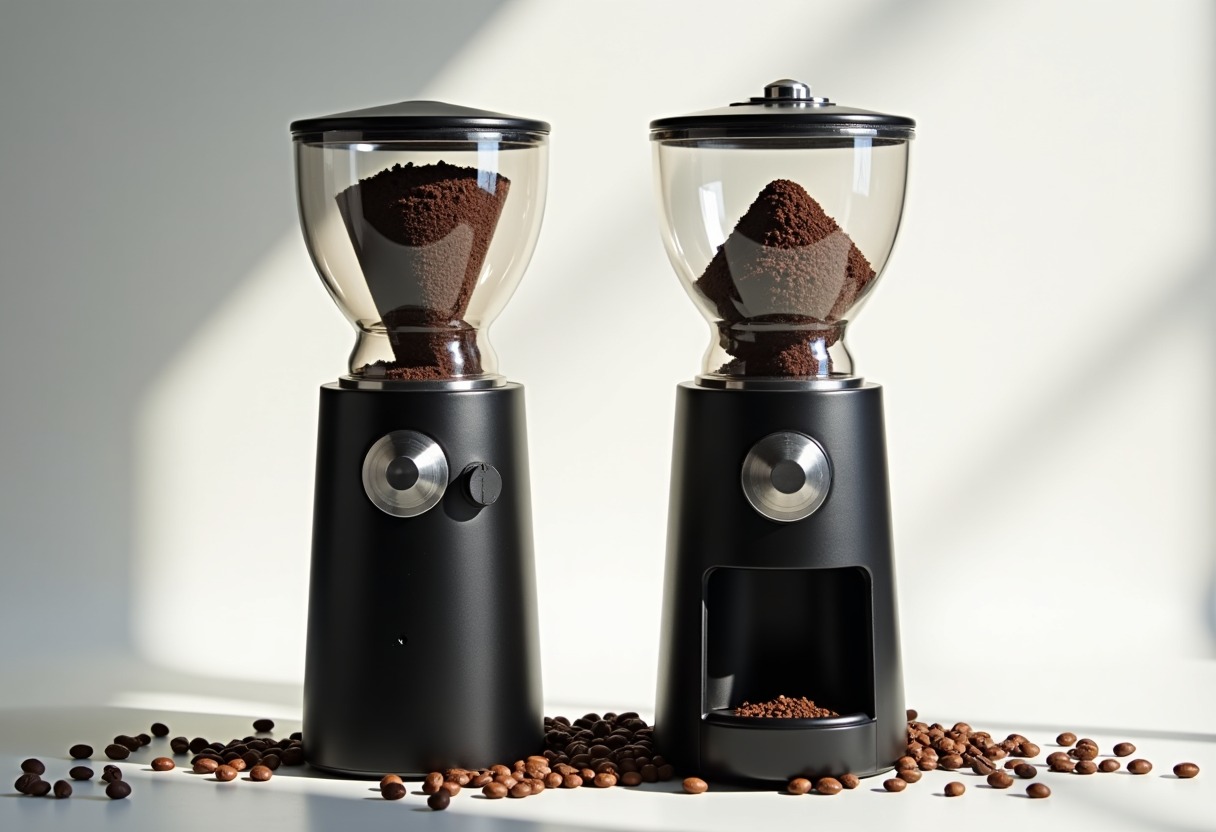
Burr geometry shapes your espresso's flavor profile more than most home baristas realize. Conical and flat burr grinders don't just look different — they produce fundamentally different particle distributions that directly affect extraction rates, flow resistance, and the balance of flavors in your cup.
Why Burr Geometry Matters for Espresso Extraction
The Specialty Coffee Association recognizes grind consistency as one of the most critical variables in espresso brewing. But consistency means more than uniform particle size — it's about the specific distribution of particles that your grinder geometry creates.
Conical burrs use a cone-shaped inner burr that sits inside a ring-shaped outer burr. Coffee beans enter from the top and get crushed and sheared as they spiral downward between the burrs. The grinding action combines crushing with some cutting, creating a wider particle size distribution.
Flat burrs position two parallel discs with matching cutting teeth facing each other. Beans get pulled into the center and ground outward by centrifugal force. This geometry emphasizes cutting over crushing, producing a more uniform particle distribution with fewer fines and boulders.
The particle distribution directly impacts water flow through your espresso puck. More uniform particles from flat burrs create more predictable flow paths and extraction rates. The mixed distribution from conical burrs can create both faster and slower extraction zones within the same puck.
Conical Burr Characteristics: The Bimodal Distribution
Conical burrs create what coffee scientists call a bimodal particle distribution — two distinct peaks in the size histogram. You get a concentration of medium-sized particles with smaller peaks of both fines and larger chunks.
This distribution affects extraction in specific ways. The fines extract quickly and contribute body and sweetness early in the shot. The medium particles provide the backbone extraction. The larger pieces extract more slowly, adding complexity but potentially sourness if the shot runs too long.
The crushing action of conical burrs also affects coffee cell structure differently than flat burrs. The compression can break cell walls in ways that expose different flavor compounds, often creating more aromatic volatile compounds that contribute to perceived sweetness and fruit notes.
Temperature retention becomes crucial with conical burrs because the varied particle sizes respond differently to heat. The → Shop conical burr grinders on Amazon typically run cooler than flat burr grinders due to lower RPM operation, which preserves aromatics but may require longer preheating for optimal extraction.
Conical burrs excel with light to medium roasts where you want to preserve fruit acids and aromatic compounds. The bimodal distribution helps balance extraction — fines provide body while larger particles prevent over-extraction of bitter compounds.
Flat Burr Precision: Uniform Extraction Dynamics
Flat burrs produce a more normal (bell curve) particle distribution centered around your target size. This uniformity means more predictable extraction timing and less variation shot-to-shot.
The cutting action of flat burrs creates more surface area per particle compared to the crushing action of conicals. More surface area means faster extraction potential, which works well for medium to dark roasts where you want efficient extraction without pulling harsh tannins.
Flat burr grinders typically operate at higher RPMs, generating more heat but also more consistent particle shapes. The parallel cutting edges create particles with more consistent geometry, leading to more uniform packing density in your portafilter.
Flow rate becomes more predictable with flat burr particle distributions. The uniform size creates consistent channels for water flow, making it easier to dial in extraction times and reducing the impact of minor puck preparation variations.
→ Shop flat burr coffee grinders on Amazon often require more precise dosing and timing because the uniform extraction leaves less room for error. A few seconds over or under optimal timing has more dramatic impact than with conical burr distributions.
Direct Comparison: Performance Metrics
| Characteristic | Conical Burrs | Flat Burrs | |---|---|---| | Particle Distribution | Bimodal (fines + chunks) | Normal (uniform bell curve) | | Extraction Profile | Complex, forgiving timing | Precise, timing-sensitive | | Heat Generation | Lower (slower RPM) | Higher (faster RPM) | | Roast Compatibility | Light to medium optimal | Medium to dark optimal | | Shot-to-shot Consistency | More variation acceptable | Requires strict consistency | | Flavor Profile | Aromatic, complex, sweet | Clean, balanced, efficient | | Puck Resistance | Variable flow zones | Uniform flow resistance | | Grind Retention | Higher (geometry traps grounds) | Lower (efficient clearing) |
The choice between geometries often comes down to your preferred extraction style. If you enjoy experimenting with different timing and pressure profiles, conical burrs give you more flexibility. If you want repeatable, dialed-in shots with minimal variation, flat burrs provide better consistency.
Specific Grinder Recommendations by Burr Type
For conical burr excellence, the Baratza Vario-W offers 64mm ceramic burrs with micro-adjustments perfect for light roast single origins. The larger burr size reduces heat generation while maintaining the complex particle distribution that makes conical burrs shine.
The Eureka Mignon Specialita represents the sweet spot for flat burr performance in home kitchens. Its 55mm hardened steel burrs produce the uniform distribution ideal for medium roasts, while the stepless adjustment allows precise dialing for different beans.
→ Shop espresso burr grinders on Amazon in the premium category, where both the Mahlkönig Peak (conical) and the Lagom P64 (flat) showcase their respective geometries at the highest level.
Budget-conscious upgraders should consider the Baratza Encore ESP for conical burr grinding or look at → Shop 64mm burr grinders on Amazon for flat burr options that provide commercial-grade particle distribution.
For those building a complete setup, pairing your grinder choice with the right espresso machine matters. Check our guide on Best Espresso Grinders Under 300 for budget-friendly options or Best Espresso Machines Home 2026 for matching your grinder to the right brewing platform.
Advanced Burr Selection: Beyond Basic Geometry
Burr material affects particle shape within each geometry type. Steel burrs create sharper cuts and more angular particles, while ceramic burrs produce more rounded particles with different extraction characteristics. The sharper edges from steel flat burrs can create more uniform surface area for extraction.
Burr size multiplies the effect of geometry differences. Larger burrs (64mm+) reduce heat generation and improve consistency regardless of geometry, but they amplify the natural characteristics of each type. A 64mm conical produces more pronounced bimodal distribution than a 40mm conical.
→ Shop coffee grinder burr sets on Amazon become relevant when upgrading existing grinders. Replacing worn burrs with different materials or tooth patterns can shift your grinder's particle distribution without buying a new machine.
Calibration methodology differs between burr types. Conical burrs require different zero-point finding techniques because their particle distribution masks subtle grind changes. Flat burrs show grind adjustments more clearly but require more precise incremental changes.
Understanding your water chemistry becomes more critical with flat burr grinders because uniform extraction amplifies water quality issues. If you're using soft water or have mineral content concerns, the forgiving nature of conical burr extraction might mask problems that flat burrs reveal.
FAQ
Which burr type works better for light roast single origins?
Conical burrs excel with light roasts because their bimodal particle distribution preserves the delicate aromatic compounds while providing enough body through fines extraction. The crushing action creates less heat, preserving volatile aromatics that make light roasts special. Light roasts also benefit from the more forgiving extraction timing that conical distributions provide, since under-extraction is more problematic than slight over-extraction with light roasts.
Do flat burr grinders really require more maintenance than conical burrs?
Flat burr grinders typically require more frequent cleaning because their geometry tends to retain fewer grounds but accumulates oils more readily on the parallel surfaces. However, they're often easier to disassemble and clean thoroughly when you do maintenance. The higher RPM operation means more frequent burr replacement (every 500-750 pounds vs 750-1000 pounds for conicals), but the uniform wear patterns make performance degradation more predictable.
Can I use the same grind setting across different bean origins with each burr type?
Conical burrs handle bean variation better within the same roast level because their bimodal distribution compensates for density differences between origins. You might only need 1-2 adjustment steps when switching from Brazilian to Kenyan beans. Flat burrs require more precise adjustment (3-5 steps) because their uniform extraction amplifies the differences in bean density, oil content, and cell structure between different origins.
How does burr geometry affect espresso machine compatibility?
Conical burr particle distributions work better with machines that struggle with flow control or have inconsistent pressure profiles, because the varied particle sizes create natural flow regulation. Flat burr distributions pair better with advanced machines that offer flow profiling or pressure ramping, since the uniform particles respond predictably to pressure changes. Manual lever machines often work better with conical burrs due to their forgiving extraction characteristics.
What's the real-world difference in shot consistency between burr types?
With proper technique, flat burr grinders produce shots that vary less than 2-3 seconds in timing and maintain consistent flow rates shot-after-shot. Conical burr shots might vary 5-8 seconds in timing but often taste more similar despite the timing differences, because the bimodal distribution creates natural compensation between fast-extracting fines and slow-extracting chunks. The practical result is that flat burrs require more precision in dosing and distribution, while conical burrs forgive minor preparation inconsistencies.
The geometry of your burrs shapes every cup you pull, from the initial resistance as water meets coffee to the final drops that determine your shot's balance and complexity.
Some links on this page are affiliate links. We may earn a small commission if you purchase through them, at no extra cost to you.
As an Amazon Associate we earn from qualifying purchases. This article contains affiliate links; if you buy through them we may earn a small commission at no additional cost to you.