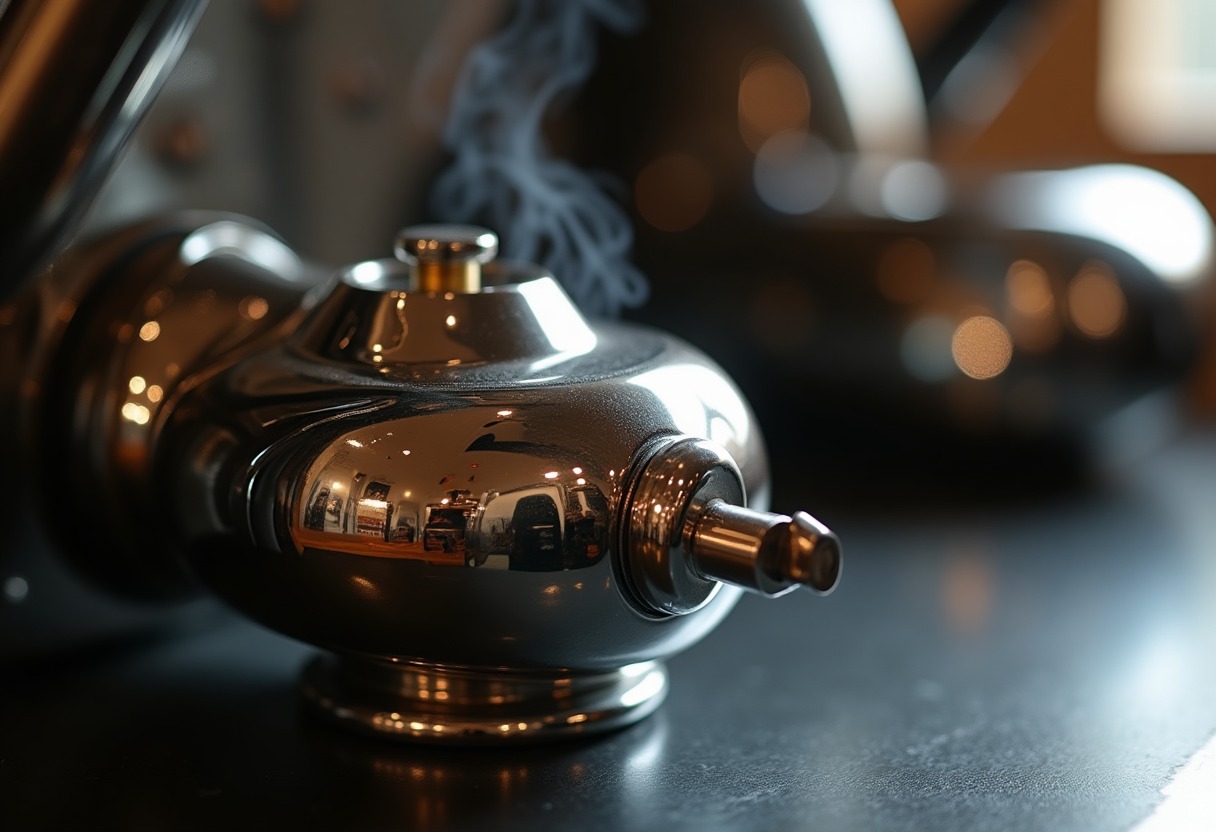
Your machine's group head determines how stable your brew temperature stays across back-to-back shots, how much thermal mass cushions against temp swings, and whether you need a 20-minute warmup or can pull acceptable espresso in five. E61, saturated, and semi-saturated designs approach this problem differently — mass versus surface contact versus active heating — and the choice affects everything from shot consistency to your workflow.
Why Group Head Design Controls Temperature Stability
Espresso extraction requires brew water within a 2-3°F window of your target temperature — typically 200-204°F for medium roasts — to avoid under-extraction sourness or over-extraction bitterness. According to the Specialty Coffee Association's brewing standards, temperature variance beyond this range produces measurably different extraction yields and flavor profiles.
The group head acts as the thermal bridge between boiler and portafilter. Poor thermal coupling means your first shot after idle time extracts at one temperature, your second shot pulls 5-8°F cooler due to portafilter heat sink effects, and recovery takes 3-5 minutes between pulls. Good group head design maintains temperature within 1°F across consecutive shots and recovers in under 90 seconds.
Three dominant architectures handle this challenge: E61 thermosyphon groups (continuous circulation, high mass), saturated groups (boiler-mounted, direct contact), and semi-saturated groups (externally heated, moderate mass). Each trades off thermal capacity, recovery speed, and mechanical complexity.
E61 Group Head Thermal Performance
The E61 group — designed by Faema in 1961, now licensed across dozens of manufacturers — uses a thermosyphon loop to continuously circulate hot water from the boiler through internal passages in the group head. This creates a 4-6 lb thermal mass that stays within 2-3°F of boiler temperature during idle periods.
Thermal stability on E61 groups depends on circulation rate and warmup time. Cold start to stable temperature takes 25-35 minutes because you're heating several pounds of brass. Once stabilized, the circulating water cushions against temperature drop when you lock in a cold portafilter — typical temp swing is 3-5°F on the first shot, recovering to stable temp within 90-120 seconds.
Heat exchange E61 machines (single boiler serving both steam and brew) show more temperature variance than dual boiler E61s because brew temperature depends on steam boiler pressure. You'll see 8-12°F swings between first thing morning and after steaming milk unless you temperature surf — flushing water to cool the group before pulling a shot. → Shop E61 espresso machines on Amazon
Dual boiler E61 machines pair the thermosyphon group with a dedicated brew boiler controlled by PID. This combination delivers the thermal mass benefits of E61 with tight temperature control — typically ±1°F measured at the group head. Machines like the Profitec Pro 700 or Lelit Bianca use this setup for consistent multi-shot sessions without cooling flushes between pulls.
The E61's main limitation is warmup time and energy consumption. Continuous circulation means the group stays hot 24/7 if you leave the machine on, drawing 50-80 watts even at idle. For home users pulling 2-4 shots daily, that's either a long morning wait or constant standby power.
Saturated Group Head Architecture
Saturated groups mount the group head directly to the brew boiler or a heated chamber, creating direct metal-to-metal thermal contact. No circulating water, no thermosyphon passages — just a solid brass or stainless group bolted to a heat source with water filling the internal chamber.
This design achieves faster warmup than E61 — typically 12-18 minutes from cold to stable temperature — because you're heating less total mass and relying on conduction rather than water circulation. Thermal stability matches or exceeds E61 performance once warmed up, with temperature swings under 2°F on consecutive shots.
Commercial machines from La Marzocco, Synesso, and Slayer use saturated groups almost exclusively because they handle high-volume workflow better than thermosyphon designs. The group head stays in constant contact with the boiler, so recovery time between shots is under 60 seconds even after pulling multiple drinks. → Shop dual boiler espresso machine on Amazon
Home machines with saturated groups include the Decent DE1, Lelit Bianca V3 (switched from E61 to saturated in the latest version), and various ECM and Profitec models. Temperature control is typically PID-regulated with accuracy to ±0.5°F measured at the brew chamber.
The tradeoff with saturated groups is thermal load on the boiler. Because the group mounts directly to the heat source, any portafilter temperature loss pulls heat from the same chamber supplying brew water. High-end machines compensate with larger boilers (1.5-2L brew boilers common) and higher wattage heating elements. Budget machines sometimes use smaller boilers that show temperature instability during back-to-back shots.
Semi-Saturated Group Heads: The Middle Ground
Semi-saturated groups place a heating element or heated metal jacket around the group head body, heating it externally rather than through water circulation or direct boiler contact. This creates moderate thermal mass — more than a basic aluminum group, less than a full E61 — with faster warmup than either saturated or thermosyphon designs.
Warmup time runs 8-15 minutes depending on element wattage and group mass. Temperature stability sits between E61 and saturated performance: expect 3-4°F swings on the first shot after the portafilter locks in, with recovery in 60-90 seconds. Not quite the rock-solid consistency of a proper saturated group, but closer than entry-level machines with unheated groups.
Breville uses this approach on the Dual Boiler and Oracle Touch — a heated ring around the group body maintains temperature independent of the brew boiler. Rancilio Silvia Pro employs a similar design. The benefit is lower cost than saturated groups and faster warmup than E61, making it practical for home users who don't want a 30-minute morning routine.
The limitation shows up in temperature distribution across the group face. E61 and saturated designs heat the entire group uniformly through water contact. Semi-saturated groups heat from the outside in, sometimes creating temperature gradients of 2-4°F between the center of the group face and the outer edge where the portafilter basket 58mm seals. This rarely matters for light to medium roasts, but can cause uneven extraction on ultra-light roasts where temperature uniformity matters more.
Group Head Type Comparison
| Group Type | Warmup Time | Temp Stability | Recovery Time | Typical Use Case | |------------|-------------|----------------|---------------|------------------| | E61 Thermosyphon | 25-35 min | ±2-3°F (HX), ±1°F (DB) | 90-120 sec | Home machines prioritizing thermal mass, traditional espresso workflow | | Saturated | 12-18 min | ±0.5-2°F | 45-60 sec | High-volume use, commercial settings, advanced home setups | | Semi-Saturated | 8-15 min | ±3-4°F | 60-90 sec | Home machines balancing warmup speed and temperature control | | Basic Unheated | 5-10 min | ±8-12°F | 2-4 min | Entry-level machines, single boiler designs |
Temperature stability measurements assume proper warmup time, quality PID control where applicable, and proper espresso machine PID controller tuning. Real-world performance varies with ambient temperature, portafilter preheat habits, and shot frequency.
Choosing Group Head Type for Your Setup
Match group head design to your actual workflow. If you pull 2-3 shots every morning and leave the machine off between sessions, E61 warmup time becomes a daily friction point unless you're willing to put the machine on a timer. Semi-saturated designs make more sense for intermittent use.
For back-to-back shot production — entertaining, dialing in new beans, pulling multiple milk drinks — saturated groups maintain consistency better than other designs. The shorter recovery time means you're not waiting between drinks, and temperature doesn't drift during extended sessions.
Heat exchange E61 machines work when you understand temperature surfing and don't mind the learning curve. Dual boiler E61s or saturated groups eliminate that workflow friction but cost more. Budget matters, but so does your tolerance for temperature management ritual versus set-it-and-forget-it consistency.
Consider pairing group head choice with grinder capability. If you're running a Best Coffee Grinders Espresso that can dial in grind precisely, temperature stability becomes more critical because you're working in tighter extraction windows. Entry-level grinders with more variance can mask group head temperature swings — not ideal, but it affects purchasing priority.
The Espresso Brew Temperature Guide covers target temperatures for different roast levels, but group head design determines whether you can actually hold those targets consistently. Light roasts demand tighter temperature control — ±1°F preferred — making saturated groups the better choice. Medium to dark roasts tolerate 2-3°F variance without obvious flavor shifts.
→ Shop heat exchange espresso machine on Amazon
Advanced Thermal Management Techniques
Install a group head thermometer to measure actual brew temperature rather than trusting the PID readout. Most PIDs measure boiler temperature, not water temperature at the point of contact with coffee. Group head measurement shows you real-world variance and helps tune PID offsets.
Portafilter preheat matters more than most people realize. A cold portafilter pulls 8-15°F of heat from the group on first contact, causing temperature instability that takes multiple shots to recover. Leave your portafilter locked into the group between shots, or keep a dedicated warming portafilter in the group and swap for your loaded basket just before brewing.
Flush timing on E61 groups requires calibration. Too short and you don't purge the cooling flush needed after steaming. Too long and you overcool the group, dropping brew temperature below target. Most medium roasts need 2-4 seconds of flush on HX machines, but test with your actual setup using the thermometer.
For machines without active group heating, run blank shots before your real pull. This preheats the shower screen, dispersion block, and group gasket — components that act as heat sinks if cold. One blank shot 30 seconds before your real pull stabilizes temperature better than any amount of idle warmup.
Temperature profiling during extraction requires saturated or semi-saturated groups with independent heating control. E61 thermosyphon design ties group temperature to boiler temperature, limiting your ability to ramp temperature mid-shot. If you care about Espresso Flow Profiling Manual Lever Machines or pressure profiling with temperature changes, group head architecture becomes a limiting factor.
FAQ
What's the actual temperature difference between E61 and saturated group heads during extraction?
Properly warmed E61 dual boiler groups hold ±1-1.5°F variance during extraction, measured at the shower screen. Saturated groups typically maintain ±0.5-1°F variance under the same conditions. The difference matters most for ultra-light roasts where extraction windows are tighter — you'll taste the 1°F difference in clarity and sweetness. For medium roasts, both designs provide adequate stability when paired with decent PID control and proper warmup time. The bigger difference shows up in recovery time between consecutive shots, where saturated groups maintain temperature 30-60 seconds faster than E61 thermosyphon designs.
Do I need to wait the full warmup time, or can I pull shots earlier if the PID shows ready?
PID-ready indicates boiler temperature reached setpoint, not that the entire group head stabilized. E61 groups need the full 25-35 minutes because you're heating pounds of brass through water circulation — early shots will pull 5-10°F cooler than target even when the PID reads stable. Saturated groups get closer to true temperature after 15-18 minutes, but short-changing warmup still causes the first shot to extract unevenly. Semi-saturated designs are most forgiving — you can pull acceptable shots 10-12 minutes in, though flavor improves with full warmup. Run a blank shot and measure group temperature with a thermometer if you want to verify actual readiness rather than trusting the timer.
Can I upgrade my machine's group head type, or is it fixed at purchase?
Group head design is built into the machine's fundamental architecture — you can't retrofit an E61 thermosyphon into a saturated group machine or vice versa. The group head physically mounts to the frame, connects to boiler plumbing, and integrates with the heating system in ways that make swapping impossible without essentially building a new machine. What you can change: shower screens, gaskets, and group head thermometers that improve performance within your existing design. Focus purchasing decisions on group head type upfront rather than planning to modify later. If thermal stability matters enough to consider group head changes, you need a different machine.
Why do commercial machines use saturated groups instead of E61 if E61 has more thermal mass?
Commercial workflow demands speed and consistency across hundreds of shots per day, not maximum thermal mass. Saturated groups recover temperature faster between shots — critical when you're pulling drinks back-to-back during rush periods. The direct boiler contact means heat replenishment happens continuously rather than relying on thermosyphon circulation that can lag under heavy use. Commercial machines also run 24/7, eliminating the warmup time advantage E61 groups might have offered. E61 designs dominate home machines because they work well for lower-volume use and the manufacturing/licensing costs are lower for mid-tier brands. Saturated groups require tighter tolerances and better engineering to prevent steam leaks and maintain pressure seals at the boiler interface.
How does group head temperature interact with pre-infusion pressure and timing?
Pre-infusion timing and pressure become more critical when group head temperature runs unstable. If your group swings 5-8°F between shots, pre-infusion gives the puck time to equalize temperature before full pressure hits — acting as a buffer against thermal variance. Machines with tight temperature control (±1°F saturated groups) show less flavor difference between 2-second and 8-second pre-infusion because extraction temperature stays consistent throughout the shot. Group heads with poor thermal stability benefit more from extended pre-infusion — 6-8 seconds at 2-3 bar helps stabilize puck temperature before the 9-bar ramp. Check out Espresso Pre Infusion Timing Pressure Curves for specific timing recommendations, but know that group head design affects how much pre-infusion pressure profiling actually matters to your final cup.
The Right Group for Your Espresso Priorities
Group head architecture determines whether you're chasing temperature between shots or pulling consistent espresso without thinking about it — E61 thermal mass works when you accept the warmup ritual, saturated designs deliver commercial-grade stability at home if you're willing to pay for it, and semi-saturated groups split the difference for daily-driver reliability.
Some links on this page are affiliate links. We may earn a small commission if you purchase through them, at no extra cost to you.
As an Amazon Associate we earn from qualifying purchases. This article contains affiliate links; if you buy through them we may earn a small commission at no additional cost to you.