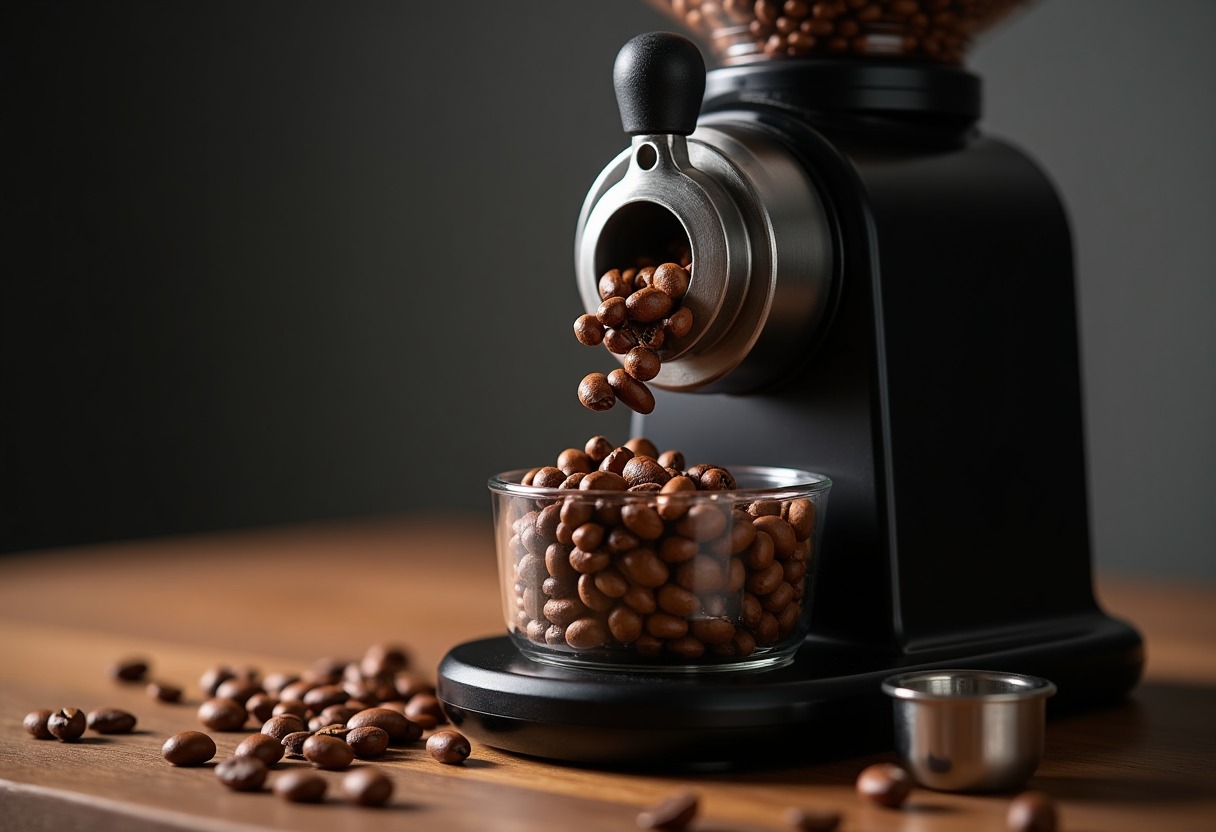
You weighed 18.0 grams of beans, but only 17.1 grams made it into your portafilter. The missing 0.9 grams are stuck to the chute walls, clinging to the burrs, or bouncing around the grinding chamber like kernels in a hot pan. That's popcorning, and it's the single biggest workflow problem in single-dose espresso grinders.
Popcorning happens when whole beans ricochet inside the grinding chamber instead of feeding smoothly into the burrs. The result is inconsistent grind times, retention that varies shot-to-shot, and ground coffee that takes forever to exit the grinder. If you're serious about dialing in espresso, you need zero-retention performance — and that means solving popcorning completely.
Why Popcorning Happens in Single-Dose Grinders
Popcorning is a mechanical problem with three root causes: bean geometry, grinder design, and static electricity.
Bean geometry creates the initial bounce. Light-roasted beans are denser and harder than dark roasts, so they bounce more aggressively when they hit the burr carrier or grinding chamber walls. Single beans entering a wide, open chamber have room to ricochet before the burrs catch them. Traditional hopper-fed grinders avoid this by maintaining constant downward pressure from the bean column above — the weight of 200+ grams keeps beans moving into the burrs.
Grinder design amplifies or mitigates the problem. Most espresso grinders weren't built for single-dosing. Their grinding chambers are sized for hopper use, creating dead space where beans can bounce. Conical burr grinders tend to popcorn more than flat burr designs because the inverted cone shape creates a wider entry area. The gap between the hopper throat and burr carrier matters — anything over 5mm gives beans enough space to redirect laterally instead of dropping straight down.
Static electricity is the retention multiplier. Grinding creates triboelectric charging — friction between beans and metal generates static that makes ground coffee cling to every surface. This is measurable: a typical grind session can generate 1-3 kilovolts of static charge, enough to hold 0.5-1.5 grams of grounds against vertical chute walls. Dark roasts generate less static than light roasts because their oils provide marginal conductivity, but all grinding creates some charge.
The Specialty Coffee Association has documented how grind consistency affects extraction uniformity, and popcorning directly undermines consistency. When beans bounce for 2-3 seconds before engaging the burrs, grind time becomes variable. When 5% of your dose clings to the chute, your puck density changes shot-to-shot.
The Three-Point Solution: Feeding, Flow, and Static Control
Eliminating popcorning requires attacking all three causes simultaneously. You need controlled bean delivery, optimized grinder geometry, and static mitigation.
Controlled feeding means one method: bellows. A grinder bellows creates positive air pressure that pushes beans through the grinding chamber and blows residual grounds out of the chute. You dose beans into a single-dose hopper, grind until the motor sound changes pitch (indicating the chamber is empty), then squeeze the bellows 2-3 times. Properly executed, this gets you within 0.1 grams of your input dose.
The bellows technique works because it reverses the air pressure gradient. Grinding creates a slight vacuum as burrs pull air downward. Bellows pressure overcomes this and physically displaces grounds that would otherwise stick. A purpose-built bellows system beats DIY solutions (squeeze bulbs, manual pumps) because the air volume and pressure are matched to the grinder's chamber size.
Flow optimization means modifying or replacing your hopper. Stock hoppers on grinders like the Niche Zero or DF64 have throats sized for bean columns, not single beans. Aftermarket single-dose hoppers reduce the throat diameter and add a funnel geometry that guides beans directly toward the burr carrier. This cuts the lateral bounce space from 12-15mm down to 3-5mm.
Some grinders ship with removable chutes designed for hopper mode. If yours has one, remove it for single-dosing. The Eureka Mignon line, for example, grinds much cleaner with the chute extension removed — beans drop straight onto the burr carrier with minimal ricochet.
Static control comes down to moisture and grounding. The Ross Droplet Technique (RDT) is non-negotiable: spray or add 1-2 drops of water to your beans before grinding. This raises the surface conductivity enough to reduce static by 60-80%. You want the beans barely damp — if you see visible water pooling, you've added too much.
For grinders that popcorn despite RDT, grounding modifications help. Some users install a wire from the grinder body to a grounded outlet, creating a static discharge path. This is more effective on metal-bodied grinders than plastic-housed models. Aluminum dosing cups also reduce static transfer compared to plastic cups when catching grounds.
Grinder Design Comparison: Popcorning Susceptibility
Different grinder architectures handle single-dosing with wildly different retention and popcorning profiles.
| Grinder Type | Popcorning Severity | Typical Retention | Mitigation Strategy | |--------------|---------------------|-------------------|---------------------| | Large Flat Burr (83mm+) | Low | 0.3-0.8g | Bellows required; benefits from tilting during grind | | Small Flat Burr (64mm) | Medium | 0.2-0.5g | RDT + bellows; single-dose hopper reduces bounce | | Conical (63-71mm) | High | 0.5-1.2g | Aggressive bellows use; consider chute removal | | Hybrid Burr (SSP) | Medium-Low | 0.2-0.6g | RDT sufficient for most; bellows for zero retention |
Large flat burr grinders like the Lagom P64 or Weber EG-1 have tighter burr carrier clearances and smaller chamber volumes relative to burr size. Beans drop straight into the grinding zone with minimal lateral movement. Conical grinders have the opposite geometry — a wide inverted cone creates a natural popcorn chamber above the burrs.
The DF64 Gen 2 and Turin grinders ship with declumpers (spinning paddles that break up clumps) that actually increase popcorning by adding another surface for beans to bounce off. Many users remove the declumper entirely when single-dosing. If you need declumping, do it after grinding with a WDT tool instead.
Retention numbers assume proper technique. A conical grinder can achieve 0.2g retention with aggressive bellows use, while a poorly-used flat burr grinder can retain 2g+ if you don't purge the chute. The numbers above represent realistic performance when you're using bellows and RDT correctly.
Product Recommendations: Building a Zero-Retention Workflow
You need three components to eliminate popcorning: the right grinder, a bellows system, and a proper dosing cup.
→ Shop single dose espresso grinders on Amazon — prioritize models designed for single-dosing from the ground up. The Niche Zero remains the benchmark: a conical grinder that minimizes popcorning through a narrow throat and minimal chute length. The DF64 Gen 2 offers flat burr performance at a lower price but requires more technique to achieve zero retention. For best-in-class grinders, the Lagom P64 and Weber Key are purpose-built for single-dosing with geometry that nearly eliminates popcorning without accessories.
→ Shop bellows for espresso grinders on Amazon — get a bellows matched to your grinder's hopper diameter. The Niche-specific bellows systems have a 58mm diameter that creates an airtight seal. Generic bellows work but require you to cup your hand around the gap to create pressure. Look for silicone construction (doesn't crack like rubber) and a rigid mounting collar that won't deform during compression.
→ Shop single-dose hoppers on Amazon — aftermarket hoppers reduce throat diameter and improve bean guidance. The Duo hopper for DF64 grinders cuts retention by 30-40% compared to stock. For Eureka Mignon grinders, the single-dose hopper replacement eliminates the bean gate mechanism that creates a popcorning pocket.
→ Shop dosing cups on Amazon — aluminum cups reduce static transfer compared to plastic. Get a 58mm cup if you're grinding into a portafilter to minimize transfer steps. Cups with measurement marks let you verify output weight without a scale mid-workflow.
→ Shop declumping tools on Amazon — WDT tools break up clumps after grinding without adding popcorning surfaces inside the grinder. Stainless steel needle designs (0.4mm thickness) work better than 3D-printed options that generate more static.
If you're working with an espresso grinder under $300, focus budget on a good bellows system before upgrading the grinder. A $200 grinder with proper technique beats a $400 grinder used poorly.
Advanced Techniques Most Guides Miss
Three advanced approaches further reduce retention and improve workflow speed.
Pre-dosing into glass vials eliminates weighing latency. Weigh 18.0g portions into small glass vials (10ml capacity), cap them, and store them near your grinder. When you're ready to pull a shot, dump the vial into the hopper and grind. This cuts 15-20 seconds off your workflow and guarantees consistent input doses. Glass doesn't generate static like plastic bags or containers. This technique matters most when you're dialing in — when you need to pull three shots in quick succession, pre-dosing removes the repetitive weighing step.
Tilt-grinding reduces chamber retention on flat burr grinders. While grinding, tilt the grinder 15-20 degrees toward the output chute. This uses gravity to help grounds exit instead of settling in horizontal chute sections. The Lagom P64 specifically benefits from this — users report retention dropping from 0.5g to 0.2g with 15-degree tilt. Don't tilt conical grinders; their vertical chutes don't have horizontal retention zones.
Controlled burr speed reduces static generation. If your grinder has variable RPM control (like many commercial-grade models), grinding at 900-1100 RPM instead of 1400+ RPM reduces friction-induced static. The burr RPM affects extraction through particle distribution, but it also affects static generation. Slower speeds mean less triboelectric charging. The tradeoff is grind time — you'll add 2-3 seconds per dose at lower RPM.
For users chasing absolute zero retention (within 0.05g), the combination technique works: RDT + bellows + tilt + slow RPM. This matters when you're pulling ultra-light roasts where 0.2g represents 1.1% of dose — enough to shift extraction yield noticeably. For typical espresso brewing, getting within 0.2g of input dose is sufficient.
The workflow sequence matters as much as the tools. Optimal order: weigh beans, RDT (2 drops), wait 10 seconds for water to distribute, dose into hopper, grind until motor pitch changes, bellows 3 times, tap grinder body twice to dislodge any stuck grounds, then catch output. This takes 35-40 seconds total and delivers 99%+ of input dose into the portafilter.
FAQ
What causes some beans to popcorn more than others in a single-dose grinder?
Bean density and roast level are the primary variables. Light roasts are 15-20% denser than dark roasts, so they carry more kinetic energy when they drop into the grinding chamber and bounce harder off surfaces.Bean size matters too — smaller beans (peaberry or small-lot varieties) can ricochet laterally more easily than large beans. The moisture content also plays a role: freshly roasted beans (less than 7 days off-roast) retain slightly more internal moisture, making them marginally softer and less bouncy than month-old beans. If you're grinding a very light Nordic-style roast, expect maximum popcorning without proper mitigation.
Can I eliminate popcorning without buying a bellows system?
You can reduce it but not eliminate it. RDT alone cuts retention by 40-60%, and removing unnecessary chute extensions or declumpers helps another 10-20%. Some users blow into the hopper after grinding (essentially manual bellows), which works but introduces moisture from breath that can cause issues over time. A purpose-built bellows costs $25-40 and delivers consistent pressure without moisture contamination. If you're grinding daily, the workflow improvement justifies the cost within a month. For occasional use, aggressive RDT plus tapping the grinder body can get you within 0.3-0.5g of input dose on most grinders.
Does popcorning affect grind consistency or just retention?
Both, and they're connected. When beans bounce for 2-3 seconds before engaging the burrs, they enter the grinding zone at inconsistent angles and speeds. This creates particle size variation — the same bean might produce a different distribution depending on whether it dropped straight down or ricocheted off the burr carrier first. The effect is small (maybe 2-3% variation in fines percentage) but measurable if you're using a sifter or particle analyzer. Retention affects consistency shot-to-shot because retained grounds from the previous dose mix with fresh grounds. If you retain 0.8g per dose, shot three contains 0.8g of stale grounds from shot two mixed with 17.2g fresh grounds — that's 4.4% contamination.
Why do conical burr grinders popcorn more than flat burr designs?
The geometry of the burr carrier creates the difference. Conical burrs have an inverted cone shape where beans drop into a wide opening at the top and funnel down to the grinding zone at the bottom. This wide entry area (often 40-50mm diameter) gives beans room to bounce laterally before they reach the burrs. Flat burr grinders have parallel burrs with a much tighter entry area (typically 20-30mm), and beans drop almost directly into the grinding zone with minimal lateral space. The vertical drop distance also matters — conical grinders often have 30-40mm of vertical space above the burr carrier, while flat burr designs minimize this to 10-15mm. Less vertical space means less time for beans to build lateral momentum before they engage the burrs.
How much retention is acceptable in a single-dose workflow?
For home use, 0.2-0.3g (1.1-1.7% of an 18g dose) is realistic and won't meaningfully affect shot quality when you're dialing in. Under 0.5g total retention means you can switch between beans without purging — the next dose will push out residual grounds from the previous bean. Above 0.5g retention, you'll taste the previous coffee in your next shot, which matters when you're comparing different origins or roast levels. Commercial settings require tighter tolerances: cafes pulling different beans shot-to-shot need under 0.1g retention to avoid flavor contamination. If you're pulling the same bean repeatedly, retention under 0.5g is fine — those retained grounds are identical to your fresh dose, so they just represent a slight dose error that you can compensate for by weighing output instead of input.
Stop Losing Beans to Physics
Popcorning is a solvable problem, not an acceptable cost of single-dosing. RDT, bellows, and proper grinder selection get you within 0.1g of zero retention, which means every gram you weigh ends up in your portafilter — no waste, no guessing, no shot-to-shot variation from retention contamination.
Some links on this page are affiliate links. We may earn a small commission if you purchase through them, at no extra cost to you.
As an Amazon Associate we earn from qualifying purchases. This article contains affiliate links; if you buy through them we may earn a small commission at no additional cost to you.