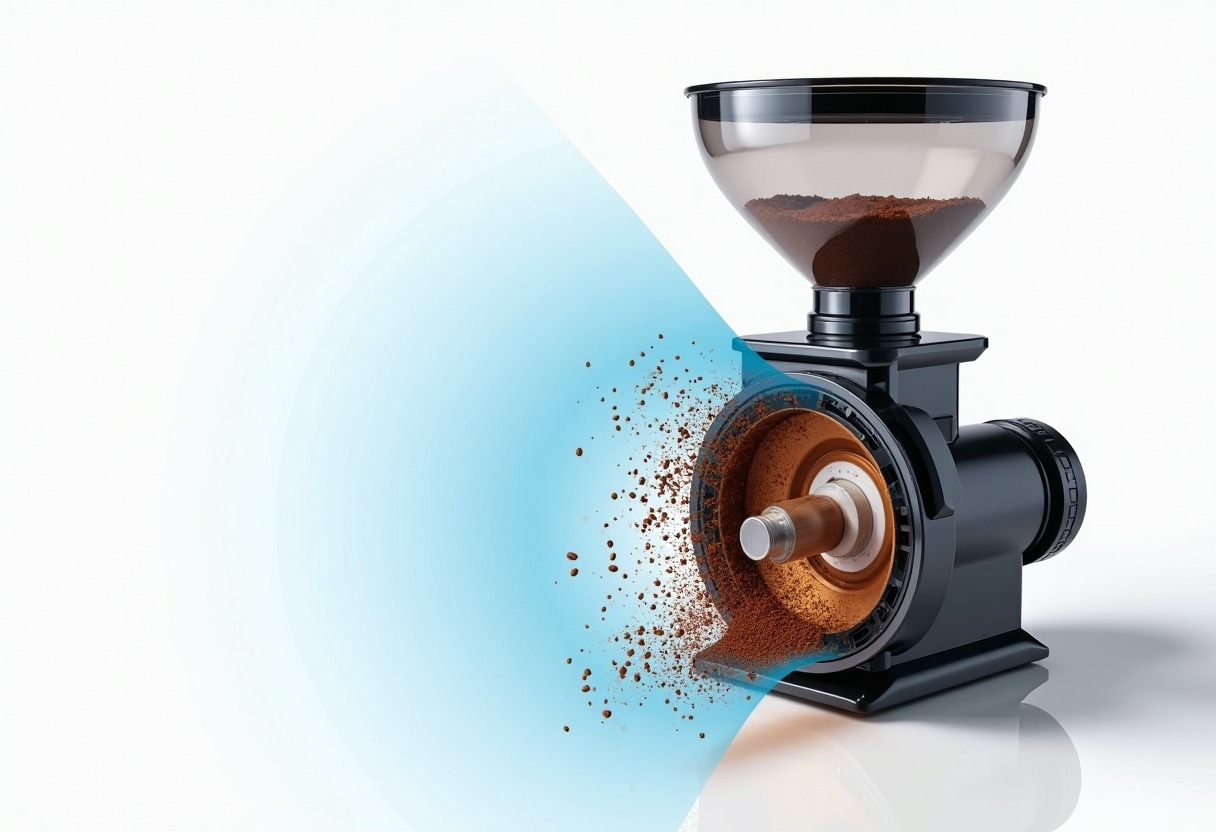
Your grinder's motor speed directly controls whether your espresso tastes bright and nuanced or flat and burnt. Most home baristas obsess over grind size and forget that burr grinder RPM speed affects particle consistency, heat generation, and ultimately extraction quality in ways that no amount of technique adjustments can fix.
Why Burr Grinder RPM Speed Controls Your Espresso's Fate
Commercial-grade grinders typically operate between 400-900 RPM for espresso applications, while many home grinders spin their burrs at 1,200-1,400 RPM. This difference isn't arbitrary — it's physics. Higher RPMs generate more heat through friction, breaking down volatile aromatic compounds that give coffee its complexity. According to the Specialty Coffee Association, maintaining temperature control during grinding preserves up to 23% more aromatic compounds compared to high-heat grinding scenarios.
Fast-spinning burrs also create more particle fines — dust-like fragments that clog your espresso puck and cause bitter over-extraction. When burrs rotate slowly, they slice through coffee beans rather than smashing them, producing more uniform particle sizes and fewer fines. This translates to cleaner extractions and better shot consistency.
The motor's torque output matters as much as its speed. High-torque, low-RPM motors maintain consistent grinding speed under load, preventing the speed variations that create uneven particle distributions. When your grinder slows down mid-grind due to insufficient torque, it produces a mix of coarse and fine particles that extracts unevenly.
Heat Generation: The Silent Killer of Coffee Flavor
Heat kills coffee faster than time does. When burr surfaces exceed 140°F during grinding, they begin destroying volatile compounds responsible for fruit notes, floral aromas, and acidity brightness. High-RPM grinders routinely hit 160-180°F during normal operation, essentially pre-cooking your beans before you even start brewing.
Temperature rise correlates directly with grinding speed and duration. A 1,400 RPM grinder grinding 18 grams for espresso generates 40-60% more heat than a 600 RPM grinder completing the same task. The difference becomes exponential with larger doses — grinding 50 grams for batch brew can raise temperatures by 80-100°F in fast grinders versus 20-30°F in slow models.
Low-RPM grinders dissipate heat more effectively because they spend more time per revolution allowing air circulation around the burrs. This natural cooling prevents temperature buildup and preserves the coffee's original flavor profile. → Shop low RPM burr grinders on Amazon
The material composition of your burrs affects heat retention differently. Steel burrs conduct and retain heat longer than ceramic alternatives, making RPM control even more critical for steel burr grinders. Ceramic burrs remain cooler during operation but require higher torque motors to prevent stalling under load.
RPM Speed Comparison: Fast vs Slow Grinders
| Grinder Speed | RPM Range | Heat Generation | Particle Consistency | Best Use Case | Example Models | |---------------|-----------|-----------------|---------------------|---------------|----------------| | Ultra-Slow | 200-400 | Minimal | Excellent | Single-dose espresso, light roasts | Manual grinders, some electric singles | | Slow | 400-600 | Low | Very good | Daily espresso, all roast levels | Commercial espresso grinders | | Medium | 600-900 | Moderate | Good | High-volume espresso, darker roasts | Prosumer home grinders | | Fast | 900-1400+ | High | Variable | Convenience grinding, pre-ground storage | Entry-level electric grinders |
Fast grinders excel in commercial settings where speed matters more than perfect extraction, but they require larger burr sets to compensate for heat generation. A 75mm burr spinning at 900 RPM generates less heat per gram than a 58mm burr at the same speed due to increased surface area and thermal mass.
For home espresso applications, slower speeds consistently produce better results unless you're grinding more than 100 shots daily. The 2-3 extra seconds required for slow grinding pays dividends in cup quality and grind consistency. → Shop high torque coffee grinders on Amazon
Product Recommendations: Grinders That Get Speed Right
The Eureka Mignon Specialita operates at 420 RPM with a high-torque motor that maintains consistent speed under load. Its 55mm flat burrs produce espresso-appropriate particles with minimal fines generation, making it ideal for single-dose workflows. The slow speed keeps grinding temperatures below 100°F even during back-to-back dosing. → Shop precision coffee grinders on Amazon
For larger budgets, the Lagom P64 combines a 350 RPM motor with 64mm SSP burrs for exceptional particle uniformity. Its ghost tooth burr geometry works best at slow speeds, creating incredibly even extractions that highlight coffee origin characteristics. The motor's high torque prevents stalling even with light roast beans.
The Niche Zero's 330 RPM speed paired with 63mm conical burrs produces some of the most consistent home espresso grinds available. Its unique single-dose design eliminates retention while the slow motor prevents flavor degradation from heat buildup. The conical burr geometry creates less fines than flat burrs at equivalent speeds.
Commercial users should consider the Mahlkonig EK43, which spins its massive 98mm burrs at just 800 RPM. The large burr diameter compensates for the moderate speed, producing high throughput while maintaining temperature control. Its stepless adjustment allows precise espresso tuning. → Shop commercial grade burr grinders on Amazon
Manual grinders like the Comandante C40 operate at whatever speed you crank, typically 60-120 RPM for comfortable grinding. This ultra-slow speed produces zero heat generation and exceptional particle consistency, though the time investment limits practical daily use. → Shop espresso burr grinder motors on Amazon
Advanced RPM Considerations Most Reviews Miss
Motor type affects speed consistency under varying loads. AC induction motors maintain more consistent RPMs than DC motors when grinding density changes between bean origins or roast levels. This consistency translates to more predictable particle size distributions across different coffees.
Gear reduction ratios determine the relationship between motor speed and burr speed. A 3:1 gear reduction allows a 1,200 RPM motor to drive burrs at 400 RPM while maintaining high torque. Direct-drive systems eliminate gear noise but require motors specifically designed for low-speed, high-torque operation.
Burr alignment becomes more critical at slower speeds because inconsistent burr spacing creates proportionally larger particle size variations. A misaligned fast grinder might produce 15% oversized particles, while the same misalignment in a slow grinder creates 25% variations due to the longer contact time between beans and burr surfaces.
Understanding your grinder's thermal characteristics helps optimize grinding protocols. Monitor your grinder's temperature after grinding by touching the burr housing — if it's noticeably warm, you're losing flavor compounds. For temperature-sensitive light roasts, allow 30-60 seconds between grinding sessions to prevent cumulative heat buildup.
Single-dosing works particularly well with slow grinders because the extended grinding time doesn't compound retention issues. Hopper-fed fast grinders trap more ground coffee in their chambers, leading to stale mixing when grinding fresh beans. This makes slow, single-dose grinders ideal for rotating between multiple coffee origins.
Your Best Coffee Grinders Espresso choice should prioritize RPM speed over features like programmable timers or digital displays, especially if you care about extraction quality. Speed affects every shot you pull, while convenience features only matter during setup.
FAQ
What RPM speed should I look for in an espresso grinder? Target grinders operating between 300-600 RPM for optimal espresso performance. This range provides the best balance of particle consistency, minimal heat generation, and reasonable grinding speed for daily use. Grinders above 900 RPM prioritize convenience over quality, while those below 300 RPM become impractically slow for regular use unless you're using a manual grinder.
Do slower grinders always produce better espresso? Slower grinders generally produce better espresso due to reduced heat generation and improved particle consistency, but extremely slow speeds below 200 RPM can become counterproductive. The ideal range balances grinding quality with practical workflow considerations. Manual grinders at 60-120 RPM produce exceptional results but require significant time investment, making them impractical for busy morning routines.
How much does grinder RPM affect espresso taste compared to other factors? Grinder RPM significantly impacts espresso taste, ranking just behind grind size consistency and How To Dial In Espresso technique in importance. While you can adjust brewing parameters to compensate for minor grind inconsistencies, you cannot recover flavor compounds destroyed by excessive heat generation. Studies show properly controlled grinding temperatures preserve up to 25% more volatile aromatics compared to high-heat grinding scenarios.
Can I modify my existing grinder to run slower? Most grinder motor modifications void warranties and create safety risks, making replacement more practical than modification. Some grinders allow gear ratio changes, but this requires significant mechanical expertise and often costs more than upgrading to a purpose-built slow grinder. If your current grinder runs too fast, focus on minimizing heat through smaller dose sizes, cooling between grinding sessions, and upgrading when budget allows.
Why do commercial grinders often run faster than home models? Commercial grinders prioritize throughput over individual cup quality, often grinding hundreds of doses daily where speed matters more than perfect extraction. They compensate for faster speeds with larger burr diameters, better heat dissipation, and more robust motor cooling systems. Many commercial operations also pre-grind coffee for espresso service, making immediate heat generation less critical than it would be for single-dose home brewing where coffee extracts within minutes of grinding.
Your espresso's flavor ceiling is set the moment coffee hits your grinder's burrs — choose a motor speed that preserves what the roaster worked months to develop.
Some links on this page are affiliate links. We may earn a small commission if you purchase through them, at no extra cost to you.
As an Amazon Associate we earn from qualifying purchases. This article contains affiliate links; if you buy through them we may earn a small commission at no additional cost to you.