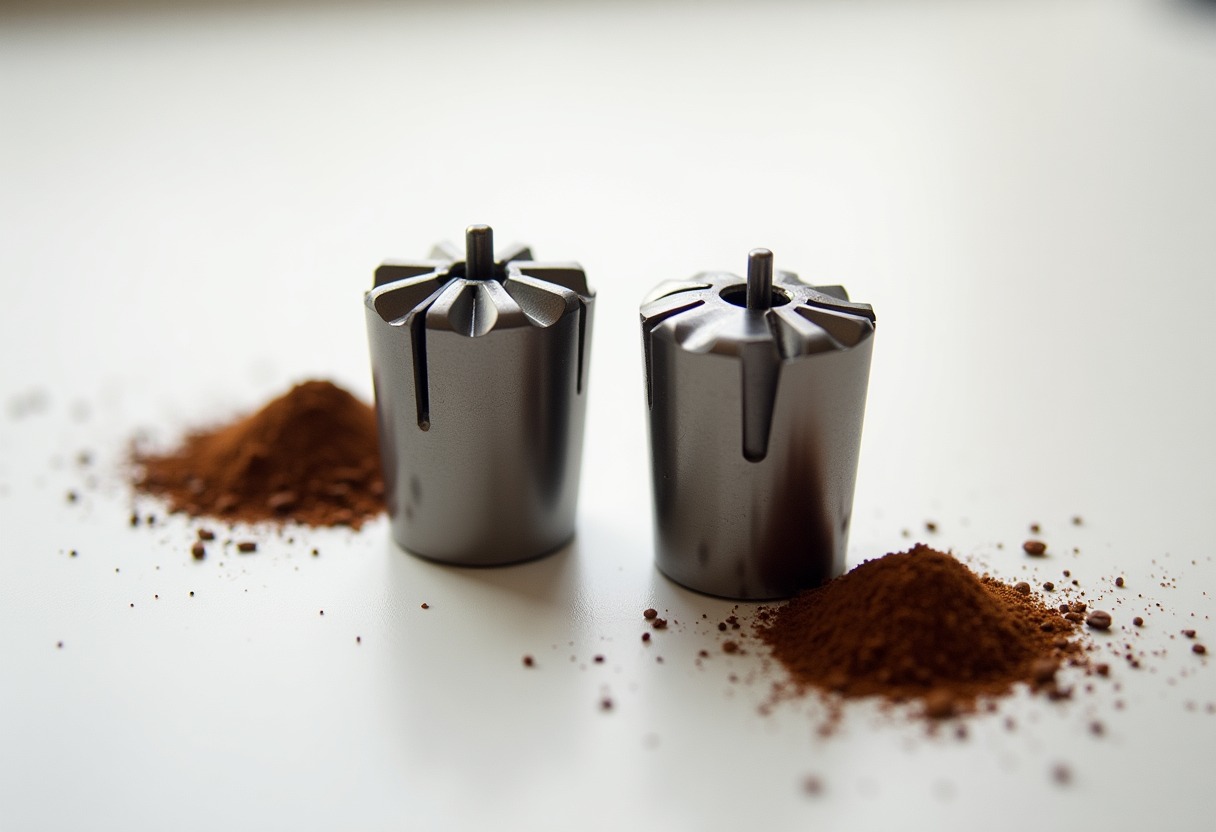
Your grinder's burrs determine 80% of your espresso's flavor potential, yet most home baristas never consider upgrading them. Factory burrs prioritize cost over precision, leaving substantial extraction quality on the table.
Why Factory Burrs Leave Money on the Counter
Stock burr sets optimize for manufacturing economics, not particle distribution. The difference shows in three measurable ways: higher fines production (those bitter dust particles), broader particle size spread, and inconsistent geometry that creates channeling during extraction.
Factory conical burrs typically produce 15-25% fines by weight, while premium aftermarket sets reduce this to 8-15%. That reduction translates directly to cleaner shots with better clarity and reduced bitterness. The Specialty Coffee Association emphasizes grind consistency as the foundation of quality extraction, making burr performance critical for any serious home setup.
Material science matters here. Stock burrs use standard tool steel with basic heat treatment, while premium options employ advanced metallurgy—think M340 steel with specialized coatings or ceramic composites that maintain edge geometry longer.
When Your Grinder Needs New Burrs
Three clear indicators signal burr replacement time: grind inconsistency you can see, declining shot quality despite proper technique, and physical wear on the cutting surfaces.
Visual inspection reveals obvious wear—rounded cutting edges, visible scratches, or uneven wear patterns. But taste tells the real story. If your shots pull unevenly despite consistent espresso dialing technique, channeling through previously reliable recipes, or requiring increasingly fine settings to achieve proper extraction times, your burrs have likely lost their edge.
Usage tracking provides objective guidance. Home burrs typically need replacement after 500-1000 pounds of coffee, depending on bean hardness and grinder quality. Light roast beans accelerate wear due to their density, while darker roasts are easier on cutting edges.
The economics favor upgrading over replacing. Quality aftermarket burrs cost $150-400 but deliver performance matching grinders costing thousands more. Upgrading a $800 grinder with $300 burrs beats buying a $1,500 grinder with mediocre stock burrs.
Aftermarket Burr Performance Comparison
Different burr geometries create distinct particle distributions and flavor profiles. Here's how the top options compare:
| Burr Set | Fines Production | Particle Spread | Best For | Price Range | |----------|------------------|-----------------|----------|-------------| | SSP High Uniformity | 8-12% | Narrow (tight distribution) | Light roasts, clarity | $350-450 | | SSP Multipurpose | 10-15% | Medium-wide | All roast levels | $300-400 | | Eureka Zenith | 12-18% | Medium | Dark roasts, body | $200-280 | | Mazzer Super Jolly | 15-20% | Wide | Traditional espresso | $180-250 |
SSP (Swiss grinding solutions) dominates the premium segment with their red speed and high uniformity geometries. The HU burrs produce exceptionally clean particle distribution but require precise alignment during installation. Their multipurpose geometry balances clarity with body, making it ideal for varying roast levels.
Eureka's aftermarket offerings target the middle ground—better than stock but less expensive than SSP. Their 65mm zenith burrs fit multiple grinder models and deliver noticeable improvement over factory options without requiring perfect calibration.
Specific Burr Recommendations by Grinder Model
For Eureka Mignon Series: → Shop SSP 64mm burr sets on Amazon deliver the biggest performance jump. The high uniformity geometry transforms these grinders into precision instruments.
For Baratza Forte/Vario: Custom SSP sets require professional installation but yield dramatic improvements. The 54mm multipurpose geometry works exceptionally well in these platforms.
For Mazzer Mini/Super Jolly: → Shop Mazzer aftermarket burr sets on Amazon offer cost-effective upgrades. Focus on hardened steel options over standard factory replacements.
For Compak/Anfim: These commercial platforms accept various aftermarket options. → Shop 75mm flat burr sets on Amazon provide multiple geometry choices.
Your grinder's current performance level determines upgrade priority. If you're already working with a quality mid-range grinder, burr upgrades deliver more impact than moving to a similar-priced grinder with stock burrs. This mirrors how Best Coffee Grinders Espresso performance scales with component quality rather than just price.
Installation and Alignment Secrets
Proper burr installation requires more precision than most guides suggest. The carrier alignment determines everything—even premium burrs perform poorly with sloppy installation.
Mark your original burr position before removal using a fine-tip marker. This reference point helps maintain calibration during reassembly. Clean the burr chamber thoroughly, removing all coffee residue and metal filings that could affect seating.
Burr carrier alignment demands patience. Install the fixed burr first, ensuring it sits flush without gaps. The moveable burr requires careful threading—cross-threading destroys expensive components. Hand-tighten initially, then use proper torque specifications from your grinder's manual.
Seasoning new burrs takes 20-30 pounds of coffee. Expect inconsistent performance initially as the cutting edges break in and find their optimal geometry. → Shop coffee grinder cleaning tablets on Amazon help remove break-in debris that can affect taste.
The first calibration after installation typically requires adjusting your entire grinding range. Premium burrs often grind finer at the same settings, so you'll need to recalibrate your espresso extraction parameters completely.
Advanced Burr Modifications
Beyond standard replacements, advanced modifications unlock additional performance. Burr coating reduces static and extends wear life—DLC (diamond-like carbon) coatings cost extra but deliver measurable benefits for high-volume use.
Shimming adjusts burr geometry for specific outcomes. Adding 0.1-0.2mm shims behind the fixed burr changes the cutting angle slightly, reducing fines production for light roast applications. This modification requires precision tools and deep understanding of grinder mechanics.
Some enthusiasts experiment with mixed burr sets—different geometries on the fixed versus moveable burrs. This approach can optimize particle distribution for specific brewing methods, though it requires extensive testing to dial in properly.
Temperature management during grinding affects burr performance. → Shop grinder cooling fans on Amazon prevent heat buildup that degrades cutting performance and creates static issues.
FAQ
How long do aftermarket burrs last compared to factory burrs? Premium aftermarket burrs typically last 2-3 times longer than factory options due to superior metallurgy and heat treatment. SSP burrs commonly handle 1,500-2,000 pounds before needing replacement, while quality steel options like Eureka's aftermarket sets manage 1,000-1,500 pounds. The harder materials and precision manufacturing translate to maintained cutting geometry over extended use.
Can I install aftermarket burrs myself or do I need professional service? Most home baristas can handle basic burr replacement with proper tools and patience. Simple swaps in grinders like Eureka Mignons require only basic mechanical skills and attention to alignment. However, grinders requiring recalibration or timing adjustments (like some Mazzer models) benefit from professional installation. The $100-150 installation cost prevents expensive mistakes and ensures optimal performance.
Do aftermarket burrs void my grinder warranty? Burr replacement typically voids manufacturer warranties, since it's considered a modification rather than standard maintenance. However, most grinder warranties expire before burrs need replacement anyway. Document your original setup with photos before modifications, and keep factory burrs for potential warranty claims. The performance benefits usually outweigh warranty concerns for serious home baristas.
Which aftermarket burrs work best for light roast espresso? SSP High Uniformity (red speed) burrs excel with light roasts due to their minimal fines production and tight particle distribution. These burrs reduce the muddy, over-extracted flavors that plague light roast espresso while enhancing clarity and origin character. Eureka's 65mm aftermarket options provide a more budget-friendly alternative that still improves light roast performance significantly over factory burrs.
How much should I expect to spend on a quality burr upgrade? Budget $200-450 for meaningful improvements, with most quality options falling in the $250-350 range. SSP sets command premium prices ($350-450) but deliver performance matching grinders costing thousands more. Eureka and other mid-tier options ($200-280) provide excellent value for moderate upgrades. Factor in installation costs if you're not handling it yourself, adding another $100-150 to the total investment.
Upgraded burrs transform decent grinders into precision instruments—often delivering more impact than buying an entirely new machine.
Some links on this page are affiliate links. We may earn a small commission if you purchase through them, at no extra cost to you.
As an Amazon Associate we earn from qualifying purchases. This article contains affiliate links; if you buy through them we may earn a small commission at no additional cost to you.