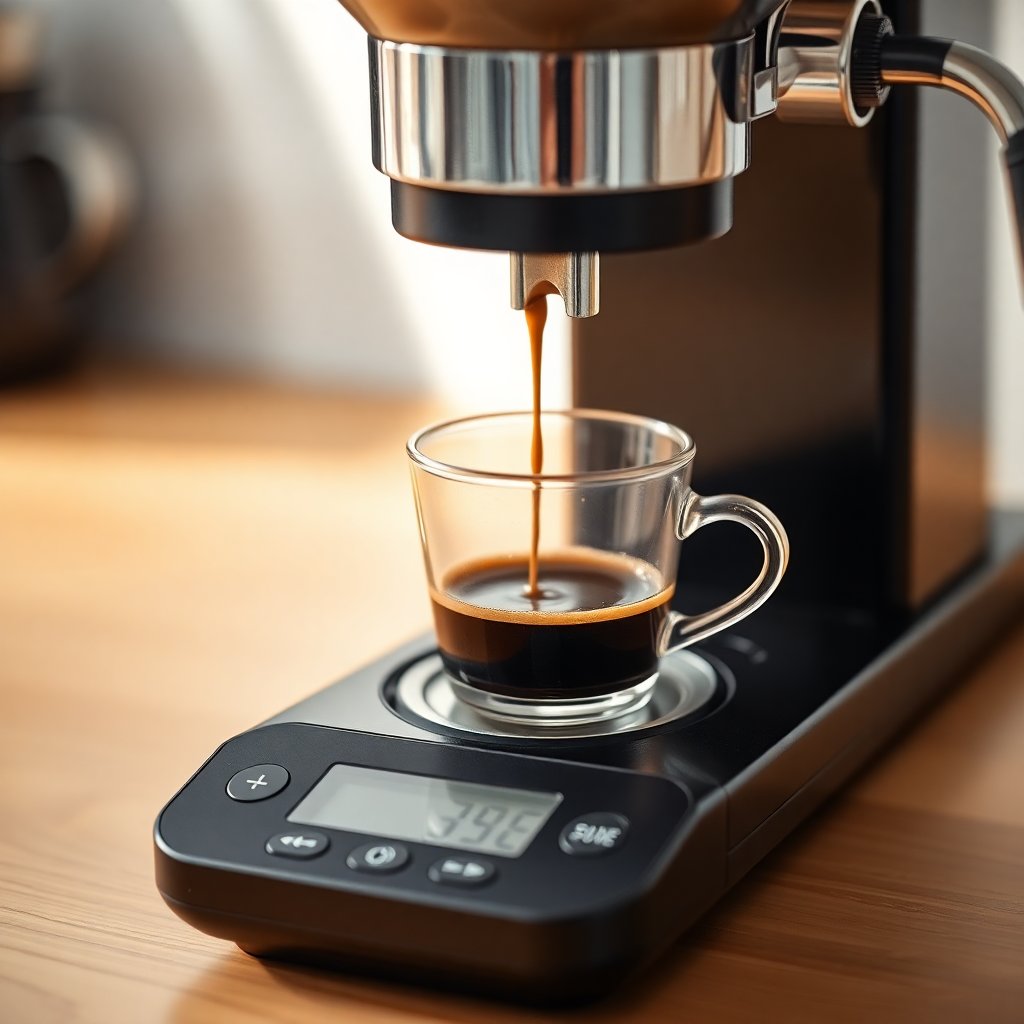
Ask a room full of home baristas which accessory improved their espresso the most and a surprising number will skip the fancy tamper and the bottomless portafilter and point at a small black box on the drip tray. A scale with a built-in timer turns espresso from guesswork into a repeatable recipe: grams of coffee in, grams of espresso out, seconds on the clock. Once you can measure all three, dialing in a new bag stops feeling like a coin flip.
It is also one of the best espresso gifts you can buy. A good scale costs a fraction of a grinder, fits any machine, and gets used every single morning.
Disclosure: PulledShot participates in the Amazon Associates program. Some links below are affiliate links, and we may earn a small commission if you buy through them at no extra cost to you.
Why Espresso Needs a Scale (Not Just a Shot Glass)
Volume is a poor way to measure espresso. Crema can make a shot look like 50 ml when the liquid underneath is closer to 30 g, and the amount of crema changes with roast date, bean, and grind. Weight sidesteps all of that.
The standard approach is a brew ratio: the weight of the espresso divided by the weight of the dry coffee. A classic starting point is around 1:2 — for example, 18 g of coffee in and roughly 36 g of espresso out — in somewhere around 25 to 30 seconds. Those numbers are a starting point rather than a law; lighter roasts often taste better at longer ratios, and darker roasts at shorter ones. Our guide on how to dial in espresso walks through adjusting grind and ratio step by step.
Without a scale and timer, you can only change one variable at a time by feel. With them, you can taste a shot, write down three numbers, and know exactly what to change next. The Specialty Coffee Association has long promoted brewing by weight for exactly this reason — it is the foundation of repeatable coffee.
What to Look For in an Espresso Scale
Response time
This is the spec that separates an espresso scale from a kitchen scale. Espresso flows fast, and a slow scale lags behind what is actually in the cup. By the time a sluggish scale reads 36 g, you may already have 39 g. Look for scales advertised with fast response; in practice, dedicated espresso scales update far more smoothly than general kitchen models.
0.1 g resolution
You want readings to a tenth of a gram, at least for the dose. A 0.5 g difference in dose is enough to change how a shot runs, so a scale that rounds to whole grams is not precise enough.
Footprint that fits your drip tray
This is where many people go wrong. Many espresso machines have very little clearance between the drip tray and the portafilter spouts, and compact machines like the Breville Bambino have small drip trays. Measure the space before you buy. Compact espresso scales are designed to fit under the cup on smaller machines, while larger scales can double for pour-over.
Built-in timer and auto-start
A built-in timer is the whole point. Better scales add auto-start, which begins timing the moment liquid hits the cup (or when the scale detects weight), plus auto-tare when you set down the cup. These features remove one more thing to juggle while you lock in the portafilter.
Water resistance and power
Scales live on a wet, hot drip tray. Look for a water-resistant design, a silicone protective mat if possible, and USB-C rechargeable batteries. Coin-cell and AAA models work, but you will be replacing batteries regularly.
Flow rate and app features (optional)
Premium scales often display a live flow rate (grams per second) and connect to apps that graph each shot. Fun and genuinely useful for diagnosing channeling and pre-infusion, but not essential for great espresso.
The Best Espresso Scales With Timer in 2026
Best Budget Espresso Scale: Compact Timer Scales Under $30
There is a whole category of inexpensive, compact coffee scales with 0.1 g resolution and a built-in timer, sold under brands like Maestri House, Greater Goods, and many others. They are not as fast as premium options, and build quality varies, but they will measure dose and yield accurately enough to transform your workflow. If you have never weighed a shot, start here.
Best for: beginners, tight budgets, and stocking-stuffer gifts.
→ Shop budget espresso scales with timer on Amazon
Best Mid-Range Espresso Scale: Timemore Black Mirror and Similar
Mid-range scales like the Timemore Black Mirror line hit the sweet spot for most home baristas. You typically get fast response, 0.1 g resolution, auto-start timing, a sleek design, and rechargeable batteries, usually at a price somewhere in the $50 to $100 range depending on the model. Several versions are sized specifically for espresso drip trays.
Best for: serious beginners and intermediate home baristas who want premium features without premium prices.
→ Shop Timemore espresso scales on Amazon
Best Premium Espresso Scale: Acaia Lunar
The Acaia Lunar has been a reference espresso scale in cafés and enthusiast home setups for years. It is compact, water resistant, very fast, and offers multiple brewing modes including auto-start and flow rate, with app connectivity. It is expensive — usually well over $200 — but it is built to survive years of daily use on a commercial drip tray.
Best for: enthusiasts with a high-end machine, and anyone who wants the scale they will never need to replace.
→ Shop Acaia espresso scales on Amazon
Best Smart Scale for Shot Graphs: Bluetooth Flow-Rate Scales
If you enjoy data, Bluetooth scales that log flow rate and pair with apps let you see each shot as a graph. Paired with a pressure gauge or a flow-profiling machine, this can make diagnosing problems like channeling and uneven extraction much easier. Brands such as Bookoo and others have brought these features to more affordable price points; check compatibility with your preferred app before buying.
Best for: data-minded enthusiasts and owners of flow-profiling or lever machines.
→ Shop Bluetooth espresso scales on Amazon
How to Use an Espresso Scale in Your Workflow
- Weigh your dose. Place your dosing cup or portafilter on the scale, tare it, and grind. Aim for the basket's rated dose (an 18 g basket typically wants something close to 18 g).
- Prep and lock in. Distribute, tamp, and lock the portafilter into the group head.
- Set up the cup. Place the scale on the drip tray, set the cup on top, and tare.
- Start the shot and the timer together. If your scale has auto-start, it will handle timing for you.
- Stop at your target yield. Stop the shot just before you hit your target weight — a few grams will still drip after you stop.
- Taste and record. Note dose, yield, and time. Sour and thin often points toward under-extraction; bitter and harsh toward over-extraction.
Once you have a recipe that tastes good, those numbers become your baseline for every new bag. Our explainer on espresso extraction yield and target ranges covers the theory behind these adjustments if you want to go deeper.
Is a Scale a Good Espresso Gift?
Absolutely, and it is one of the safest. Unlike grinders or machines, you do not need to know much about the recipient's setup — just how much room is under their portafilter. A compact scale fits almost every machine. For a higher-end espresso enthusiast who already owns a basic scale, an upgrade to a faster, auto-start model is a gift they will notice every morning.
Looking for something to pair with it? Our espresso holiday gift guide has ideas at every price, from WDT tools and puck screens to milk pitchers.
Buying Tips
- Measure your drip tray before buying — width and clearance matter more than almost any other spec.
- Prioritize response time over extra features.
- Choose USB-C rechargeable to avoid a drawer full of coin cells.
- Add a silicone mat to protect the scale from heat and spills.
- Check the return policy in case the scale does not fit under your machine.
The Bottom Line
Most home baristas should start with a compact, 0.1 g scale with a built-in timer — a budget model is fine, and it will improve your espresso more than almost any other accessory at the price. If you are already weighing shots and want a smoother workflow, step up to a mid-range scale with fast response and auto-start. And if you want a scale that will outlast your current machine, the Acaia Lunar remains the premium benchmark.
Grams in, grams out, seconds on the clock: once you start measuring, you will not want to go back.
As an Amazon Associate we earn from qualifying purchases. This article contains affiliate links; if you buy through them we may earn a small commission at no additional cost to you.